Have you ever typed “Whoa” or “Woah” and then paused, wondering which spelling is actually correct? You’re not alone. These two spellings look almost identical, sound the same, and often appear interchangeably in texts, social media posts, and everyday conversations. So, is one wrong, or do both have a place in English?
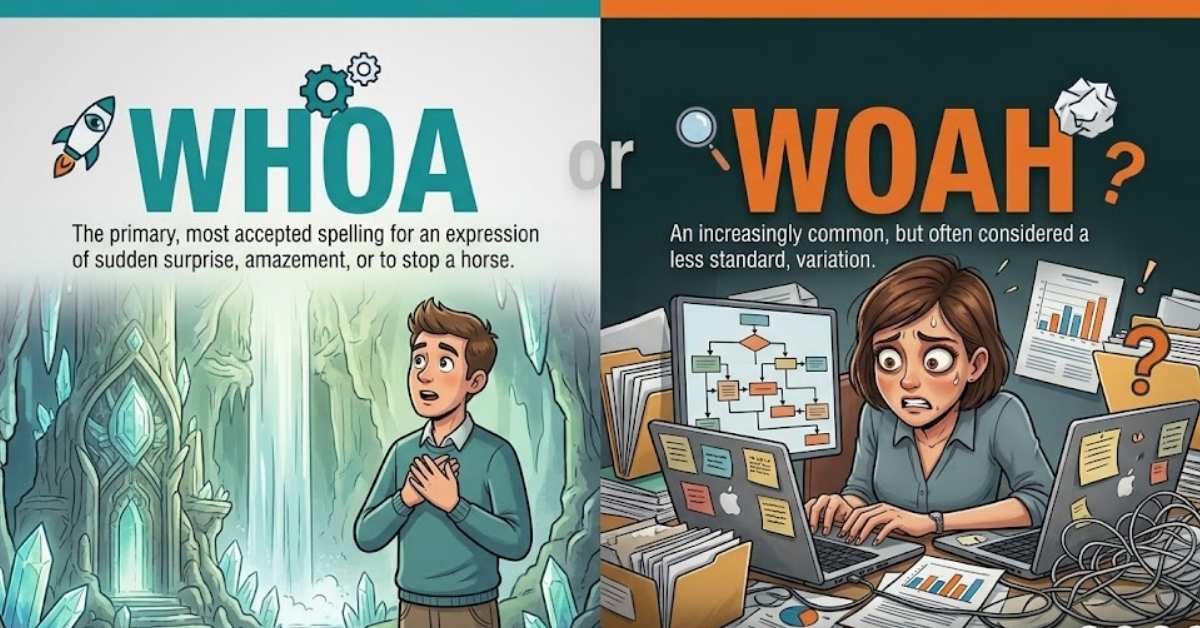
The short answer is that Whoa or Woah usually carries the same meaning. Both can express surprise, excitement, shock, admiration, or even a warning to stop. However, whoa is the standard spelling recognized by major dictionaries and preferred in formal or professional writing. Woah, while widely used, tends to appear more often in casual messages, online conversations, and creative dialogue.
Choosing between them becomes much easier when you consider your audience and setting. Writing a school assignment, professional email, or formal article? Whoa is the safer choice. Chatting with friends or writing realistic dialogue? Woah can fit naturally. Once you understand this small spelling difference, you can write with confidence without letting one little word slow you down.
Quick Answer
Whoa or Woah? If you need the safest spelling, choose whoa. It’s the traditional and standard form used in edited English.
However, woah deserves a little more nuance. Some dictionaries recognize it as a variant spelling rather than simply treating it as a mistake. Cambridge lists “woah,” “whoah,” and “woa” as variants of “whoa,” while Collins defines “woah” as a variant spelling.
For formal writing, professional writing, academic writing, articles, and blogs, whoa remains the better choice.
In casual conversations, text messages, and social media, you’ll often see woah.
Quick rule:
- Whoa: standard and preferred.
- Woah: common informal variant.
- Whoah/Woa: less common variants.
So, when credibility matters, stick with whoa.
Simple Examples
The easiest way to understand Whoa or Woah is to see both spellings in context.
“Whoa! That roller coaster was fast.”
“Woah! Did you really win?”
Both sentences clearly communicate surprise or excitement. The difference lies mainly in spelling and register.
Here are a few more examples:
- Whoa, slow down. — a warning or command.
- Whoa, that’s beautiful! — admiration.
- Whoa, I didn’t expect that. — surprise.
- Woah, that’s wild! — casual excitement.
- Whoa there, buddy. — asking someone to pause.
- Woah, look at that! — informal online reaction.
In edited or professional content, whoa usually looks more polished.
In social media comments, woah can feel perfectly natural.
Think of them as two spellings wearing slightly different outfits. The message stays similar, but the writing context changes.
Meaning of Whoa
Whoa is an interjection that expresses a sudden emotional reaction or tells someone to stop or slow down.
Its original use connects strongly with horses. A rider could say “whoa” as a command to stop or slow an animal. Over time, people began using the word with other people and in emotional situations.
Today, you might say whoa when something surprises you. You might also use it when something impresses you or moves too quickly.
Cambridge defines whoa as an exclamation used with a horse and, informally, with people. It also lists surprise and interest as modern meanings.
The word can therefore signal:
- Surprise
- Shock
- Excitement
- Admiration
- Warning
- A request to slow down
Its exact meaning depends heavily on tone and context.
Common Meanings of Whoa
The meaning of whoa changes according to the situation.
First, it can work as a warning. Someone might say, “Whoa, that’s too close!” when they notice danger.
Second, it can express surprise:
“Whoa, you finished already?”
Third, it can show admiration:
“Whoa, that view is incredible!”
It can also act as a command to stop.
“Whoa! Hold the door.”
The emotional intensity can range from mild surprise to genuine shock.
In daily conversation, speakers often stretch the word or repeat it for emphasis. Someone might say:
“Whoa, whoa, whoa. Let’s slow down.”
That repetition creates urgency.
The word wow can express admiration, but whoa often carries an extra sense of pause or sudden reaction.
So, don’t treat every use as identical. The surrounding sentence gives the interjection its real meaning.
Examples
Context makes whoa much easier to understand.
Surprise
“Whoa, you got here early!”
Shock
“Whoa! What happened to the car?”
Excitement
“Whoa, we’re actually going to the concert!”
Admiration
“Whoa, that painting looks amazing.”
Warning
“Whoa, watch where you’re stepping.”
Command
“Whoa, horse!”
Notice how the same word handles very different emotions.
The punctuation also changes the feel. A short “Whoa!” sounds stronger than a calm “Whoa, I didn’t know that.”
In dialogue, writers can use this flexibility to make conversations feel natural.
“Whoa,” Alex said, stepping back. “That’s much bigger than I expected.”
That sentence doesn’t merely communicate information. It shows an immediate emotional reaction.
Grammar Explanation

Whoa functions mainly as an interjection or exclamation.
An interjection stands somewhat outside the main grammar of a sentence. It expresses an immediate feeling, reaction, command, or response.
For example:
“Whoa! That’s fast.”
The word doesn’t describe the car’s speed grammatically. Instead, it shows the speaker’s reaction to that speed.
It can also appear inside a sentence:
“Whoa, I wasn’t expecting that.”
Because interjections often interrupt normal sentence flow, punctuation helps communicate the intended tone.
You may see a comma, exclamation mark, or period depending on the context.
The word also appears in informal speech when someone wants another person to pause.
“Whoa, let’s think about this first.”
That usage has become common in everyday conversation.
What Part of Speech Is Whoa
Whoa is generally classified as an interjection or exclamation.
Cambridge labels it an exclamation, while American dictionary sources also describe it as an interjection.
Its grammatical role makes sense because whoa usually expresses a reaction rather than naming an object or describing an action.
For example:
“Whoa! That’s incredible.”
Here, whoa doesn’t modify “incredible.” It simply communicates the speaker’s immediate reaction.
You can also place it before a statement:
“Whoa, I didn’t see that coming.”
The word remains an independent emotional signal.
In some dictionaries and historical usage, whoa can also appear in verb-like use. That form is much less common in everyday modern writing, though.
For most readers, the simplest explanation works best:
Whoa is primarily an interjection used to show reaction, caution, or a command to stop or slow down.
Correct Punctuation
Punctuation changes how whoa sounds on the page.
Use an exclamation mark when the reaction feels sudden or strong:
“Whoa! That’s huge!”
Use a comma when whoa flows into a longer statement:
“Whoa, I didn’t know that.”
You can also use a period when the reaction stands independently:
“Whoa. Let’s take a second.”
The punctuation doesn’t change the spelling. It changes the rhythm and emotional intensity.
In dialogue, punctuation becomes especially useful because readers can’t hear the speaker’s voice.
Compare:
“Whoa, slow down.”
with:
“Whoa! Slow down!”
The second version feels sharper and more urgent.
A comma works well for ordinary conversation. An exclamation mark suits surprise, shock, excitement, or strong warning.
Don’t automatically add an exclamation mark every time. Too many can make your writing feel exaggerated.
Read More : Dreamed or Dreamt: Powerful Tips to Choose Right 2026
Is Woah Grammatically Correct
Woah isn’t simply a meaningless typo. Major dictionaries recognize it as a variant of whoa.
Cambridge lists woah, whoah, and woa alongside whoa. Collins specifically describes woah as a variant spelling of whoa.
That distinction matters.
In formal writing, whoa remains the safer and more conventional choice. In informal writing, however, woah appears frequently.
You might see it in:
- Text messages
- Social media posts
- Comments
- Casual blogs
- Informal dialogue
- Online conversations
So calling woah universally “wrong” oversimplifies modern English.
A better rule is this:
Use whoa when you want the standard spelling. Use woah when the informal style or quoted voice naturally calls for it.
Grammar isn’t the only issue. Register matters too.
Why People Confuse Whoa or Woah
The confusion between Whoa or Woah mostly comes from pronunciation and everyday writing habits.
Both forms represent essentially the same spoken reaction. That makes the spelling easy to mix up.
Most people don’t pronounce every letter while speaking. Instead, they hear one short sound and later reproduce it from memory.
Several factors reinforce the confusion:
- Phonetic spelling
- Typing habits
- Social media
- Informal writing
- Familiarity with similar words
- Fast digital communication
The internet has made this even more visible.
Someone may type woah because that spelling feels closer to the sound they hear. Another person may automatically choose whoa because they’ve seen it in books.
Neither person needs to stop and think about dictionary history during a quick conversation.
The important distinction is simple: whoa is the safer standard form, while woah has established informal and dictionary-recognized use.
Phonetic Spelling
Phonetic spelling helps explain why people write woah instead of whoa.
When people spell a sound from memory, they often choose letters that seem to match what they hear.
The spelling woah looks straightforward. It resembles the pronunciation more closely to many readers because the opening letters feel familiar.
However, English spelling doesn’t always follow pronunciation neatly.
Think about words such as “enough,” “though,” and “through.” Their spelling patterns don’t always tell you exactly how they sound.
Whoa has its own history and established spelling pattern.
Cambridge gives the US pronunciation as /woʊ/ and the UK pronunciation as /wəʊ/.
Because whoa and woah sound alike in ordinary speech, pronunciation doesn’t reliably tell you which spelling to choose.
That’s why dictionary knowledge matters more than simply spelling the sound you hear.
Typing Habit
Typing habits can turn woah into a familiar spelling.
When you’re texting quickly, you rarely pause to check a dictionary. Your fingers often choose the version you’ve seen most often.
Autocorrect and predictive text can reinforce that habit too.
Imagine sending a quick message:
“Woah, that was close!”
It feels natural because the conversation is informal. Nobody is preparing a manuscript for publication.
Repeated exposure creates familiarity. If you see woah hundreds of times in comments, captions, or messages, the spelling may begin to look completely normal.
That’s one reason spelling preferences vary between people.
For polished writing, however, choosing whoa avoids unnecessary questions about correctness.
A simple habit helps: when writing something important, pause before publishing.
Use whoa for articles, professional emails, academic writing, and other edited material. Save woah for situations where its informal flavor fits naturally.
Social Media Influence
Social media has helped spread woah far beyond casual conversation.
On Twitter, Instagram, and TikTok, users often write quickly and react emotionally. Posts favor speed, personality, and immediacy over formal editing.
That environment gives informal spellings plenty of room to thrive.
You might see:
“WOAH 😳”
or:
“woah, that was insane.”
The capitalization, punctuation, and spelling all contribute to the emotional reaction.
Social media also encourages people to imitate expressions they see repeatedly. A spelling can become familiar simply because thousands of people use it.
That doesn’t automatically make every online spelling standard English.
Still, woah has moved beyond an occasional typo. Dictionaries now acknowledge it as a variant.
For social posts, either form can work. For polished content, whoa remains the stronger default.
Informal Nature of the Word
Even whoa itself often carries an informal tone.
People use it in relaxed conversations, reactions, jokes, and casual dialogue. You wouldn’t normally build a formal academic argument around the word.
For example:
“Whoa, that deadline is tomorrow?”
That sounds natural in conversation.
However, whoa can appear in professional settings when someone uses it intentionally.
A workplace message might say:
“Whoa, that’s a much larger change than expected.”
The issue isn’t that the word is forbidden. It’s that the tone and context determine whether it fits.
In formal writing, a writer might replace it with a more precise phrase such as:
“This result is surprising.”
In creative writing, keeping whoa can make dialogue feel authentic.
So, don’t ask only whether a word is correct. Ask whether it sounds right for the situation.
Historical Background of Whoa
The history of whoa reaches back several centuries.
The word developed as a command used with horses. Riders needed a short, forceful sound that could signal an animal to stop or slow down.
Over time, the expression moved beyond horseback riding.
People began using it with one another to signal caution, disagreement, surprise, or emotional reaction.
Dictionary sources trace the word to older forms related to ho. Collins gives historical information connecting whoa with earlier forms and dates one American dictionary sense to the early 17th century.
The commonly discussed 15th century background reflects the broader historical development of forms associated with the horse-stopping command.
Its meaning eventually expanded from “stop” to “hold on” and then to emotional reactions such as surprise and admiration.
That history explains why whoa can mean both “stop” and “I can’t believe that!”
Dictionary Acceptance
Dictionary acceptance gives the Whoa or Woah debate a useful answer.
Cambridge lists whoa as an exclamation and identifies woah, whoah, and woa as variants. It also gives separate meanings for stopping, slowing down, and expressing surprise or interest.
Collins goes a step further by defining woah as a variant spelling of whoa.
That means the simple claim “woah is always wrong” doesn’t tell the whole story.
Still, dictionary recognition doesn’t mean every spelling has equal status in every situation.
Whoa remains the strongest choice for standard, edited English.
Woah works naturally in informal contexts.
This distinction helps writers avoid two extremes. Calling woah completely wrong is too rigid. Treating both spellings as equally formal is also misleading.
For credibility in writing, especially published books and professional content, whoa is the safer choice.
Read More : Ageing or Aging: Simple Rules and Examples You Need 2026
Real World Usage of Whoa
Real-world usage shows why context matters more than a simple right-or-wrong rule.
People use whoa in daily conversation, text messages, social media, creative writing, dialogue, and media.
You might hear:
“Whoa, that’s expensive.”
You might read:
“Whoa! What just happened?”
You might also see:
“Woah, this song is incredible.”
The two spellings communicate the same basic reaction, but they create slightly different visual impressions.
Whoa looks more conventional.
Woah often looks more casual and internet-friendly.
Neither spelling needs to dominate every situation.
When writing an article or professional email, choose whoa. When reproducing a character’s exact informal voice, woah may fit better.
That flexibility makes the word especially useful in modern English.
Daily Conversation
In daily conversation, whoa can communicate a surprisingly wide range of reactions.
Someone might say it when a friend reveals unexpected news.
“Whoa, you moved already?”
A driver might use it as a warning.
“Whoa, watch the curb!”
A friend might use it to slow down an argument.
“Whoa, let’s not jump to conclusions.”
The spoken tone does much of the work.
A soft whoa can sound thoughtful. A sharp whoa! can signal alarm.
Because speakers naturally use gestures and facial expressions alongside the word, the meaning often feels obvious in person.
Written English doesn’t provide those visual clues. That’s why punctuation becomes important when you put the expression on a page.
In normal daily conversation, there’s no need to overthink it.
Just remember that whoa can mean “stop,” “slow down,” “wait,” or “that’s surprising,” depending on context.
Text Messages
Text messages make whoa especially useful because the word quickly communicates emotion.
Consider:
“Whoa, you actually did it!”
The message immediately signals surprise.
A friend might instead type:
“Woahhh 😭”
The extended spelling and emoji make the reaction even more expressive.
Texting gives writers freedom to bend conventional spelling. That’s why woah appears so often in casual messages.
You may also see repeated forms:
“Whoa whoa whoa 😂”
That repetition creates a conversational rhythm.
For a casual text, both spellings can work. There’s little need to treat woah as a serious error when the goal is relaxed communication.
However, if the text message belongs to a professional setting, whoa looks more polished.
The audience matters.
A message to a close friend and an email to a manager don’t follow the same writing rules.
Social Media

On social media, whoa and woah both appear frequently.
Twitter posts, Instagram captions, and TikTok comments often prioritize personality over formal spelling conventions.
For example:
“Whoa, this view is unreal.”
or:
“Woahhh, that ending 😭”
The second version feels more dramatic and casual.
Social platforms also reward quick emotional reactions. A short interjection can communicate surprise without needing a full sentence.
That makes whoa particularly useful for captions, comments, and replies.
However, social media isn’t a single writing style. A personal TikTok comment differs from a company’s professional Instagram post.
If a business wants a polished voice, whoa is the better choice.
If a creator wants an intentionally casual voice, woah can work.
The key is consistency. Your spelling should match your overall tone and audience.
Professional Writing
Professional writing calls for more restraint.
In reports, articles, professional emails, business documents, and formal communication, whoa is the safer spelling if you genuinely need the interjection.
Even then, consider whether the word belongs there.
Instead of:
“Whoa, sales increased by 40%.”
a formal report might say:
“Sales increased by 40%, which was unexpected.”
The second sentence sounds more objective.
Still, professional writing sometimes uses conversational language intentionally. A marketing article, newsletter, or personal business blog may use:
“Whoa, that was a busy quarter.”
There’s nothing inherently unprofessional about the word.
The real question is whether it supports the desired voice.
For academic writing, use it sparingly. For business writing, consider the audience. For polished articles, choose whoa over woah when the interjection adds value.
Whoa in Literature and Media
Writers have long used whoa to make dialogue feel immediate and believable.
In literature, dialogue needs to sound like something a person might actually say. A character who sees something astonishing may naturally respond:
“Whoa. I’ve never seen anything like that.”
Screenplays and subtitles use similar techniques.
The word can quickly communicate emotion without a long explanation.
It also works well in storytelling because it creates a brief pause.
“Whoa,” Alex whispered. “Did you see that?”
That tiny reaction tells readers that something unexpected just happened.
In novels, whoa can reveal personality. A relaxed character may use it often, while a formal character might avoid it.
Media also exposes readers to different spelling choices.
If a character’s dialogue intentionally uses woah, preserving that spelling can support realism in dialogue.
The goal isn’t always formal correctness. Sometimes believable speech matters more.
British vs American English
The difference between British English and American English doesn’t create a simple whoa-versus-woah divide.
Cambridge gives whoa in both varieties and lists woah, whoah, and woa as variants. Its pronunciation differs by variety, with /woʊ/ shown for US English and /wəʊ/ for UK English.
So the main distinction isn’t:
American = whoa
British = woah
That would be misleading.
Both varieties use the standard spelling whoa.
Variant spellings can appear in informal communication on either side of the Atlantic.
For formal writing, the same practical advice applies: choose whoa.
If you’re writing dialogue, social posts, or casual text, woah may appear naturally regardless of the speaker’s nationality.
Tone and context matter more than geography here.
Tone and Context of Whoa
The word whoa changes meaning through tone and context.
A softly spoken “whoa” can signal mild surprise. A sharp “Whoa!” may sound like a warning.
Consider:
“Whoa, that’s interesting.”
This sounds curious.
Now compare:
“Whoa! Stop!”
The second sentence demands immediate attention.
Context also changes emotional intensity.
A teenager might say:
“Whoa, that’s awesome!”
A worried parent might say:
“Whoa, stay right there.”
The spelling stays the same, but the emotional purpose changes.
That’s why writers shouldn’t define whoa with only one meaning.
It can communicate surprise, shock, admiration, caution, excitement, or a command to stop.
In creative writing, punctuation and surrounding actions can make that difference clear.
A short word can carry a lot of emotional weight when the context does the heavy lifting.
Surprise
Whoa often signals surprise when something happens unexpectedly.
For example:
“Whoa, you’re here already!”
The speaker didn’t expect the person to arrive so soon.
The word can also introduce surprising information:
“Whoa, I didn’t know she owned that company.”
In these situations, whoa gives the sentence an immediate emotional spark.
It tells the reader that the speaker needs a moment to process what happened.
The level of surprise can vary.
A quiet:
“Whoa…”
may suggest thoughtful amazement.
A loud:
“Whoa!”
can suggest genuine shock.
In dialogue, this makes the word useful because it shows emotion without requiring a long explanation.
If a character reacts to unexpected news, adding whoa can make the scene feel more spontaneous.
That’s especially useful in novels, screenplays, and storytelling where realism in dialogue matters.
Shock
Whoa can also express shock.
Imagine someone witnessing a sudden accident:
“Whoa! Is everyone okay?”
Here, the word doesn’t mean “stop” literally. It expresses an immediate emotional response.
Shock often gives whoa greater intensity.
Writers can reinforce that feeling with punctuation, repetition, or surrounding action:
“Whoa—whoa. What just happened?”
The repeated form suggests that the character needs time to process the event.
However, don’t rely on the word alone.
A strong scene combines dialogue with details that show what the character sees, hears, or feels.
For example:
“Whoa,” Maya said, staring at the broken window.
The action explains the emotional reaction.
In everyday speech, people often use whoa after unexpected news. In creative writing, the same habit can make characters sound more believable.
The word works best when the surrounding context gives the reader something worth reacting to.
Admiration
Whoa can express admiration when something impresses you.
“Whoa, this place is beautiful.”
“Whoa, you built that yourself?”
In these examples, the speaker isn’t warning anyone. They’re reacting to something impressive.
The word adds emotional intensity without requiring a dramatic sentence.
You can also use it for achievements:
“Whoa, you finished the entire project today?”
That reaction combines surprise with admiration.
This use overlaps with wow, but the tone can differ slightly.
“Wow” often sounds like straightforward admiration.
“Whoa” can suggest that the speaker feels momentarily overwhelmed by what they see.
That subtle distinction helps writers choose the right interjection.
In social media captions, whoa can make praise sound spontaneous.
In dialogue, it can make admiration feel genuine rather than rehearsed.
When the emotional reaction feels sudden, whoa often fits naturally.
Warning
A warning is one of the most recognizable uses of whoa.
“Whoa, watch your step!”
“Whoa! Don’t touch that.”
Here, the word tells someone to pause and pay attention.
The meaning connects directly with the word’s older command-to-stop use.
A speaker doesn’t necessarily expect someone to stop completely. They may simply want the person to slow down or reconsider an action.
The tone determines how serious the warning sounds.
“Whoa, let’s slow down.”
sounds calmer than:
“Whoa! Stop!”
Writers can use this difference to show personality.
A calm character might use whoa as a gentle caution. A frightened character may shout it.
In conversation, the word often appears before a direct instruction.
That makes it especially useful when a situation changes quickly and the speaker needs to interrupt someone’s action.
Common Mistakes and Corrections
One common mistake involves assuming that woah is always incorrect.
Modern dictionary evidence doesn’t support such an absolute rule. Cambridge lists it as a variant, while Collins calls it a variant spelling of whoa.
Another mistake involves treating whoa as a synonym for wow in every situation.
Incorrect idea: “Whoa” and “wow” always mean exactly the same thing.
They overlap, but whoa can also signal stopping or caution.
Other common mistakes include:
- Using too many exclamation marks.
- Capitalizing the word randomly.
- Treating informal spelling as formal style.
- Assuming British English uses a completely different spelling.
- Calling every use of woah a typographical error.
A good correction strategy is simple.
Use whoa as the default spelling. Understand woah as an informal variant. Then let tone and context guide the final choice.
Whoa in Creative Writing
Creative writing gives whoa room to shine.
A character’s speech should sound believable, not mechanically perfect. That’s especially true in novels, screenplays, dialogue, and storytelling.
For example:
“Whoa,” Alex said, backing away from the edge. “That’s deeper than I thought.”
The interjection creates a natural pause.
You can also use woah when a character’s voice calls for an informal spelling:
“Woah, dude. Look at that.”
That choice can help establish personality.
However, spelling shouldn’t become random. If a character consistently writes informal messages, woah may fit their voice. If the surrounding prose uses polished standard English, whoa may work better.
Creative writing isn’t about breaking rules for no reason.
It’s about making deliberate choices that serve the story.
Used thoughtfully, an interjection can add realism in dialogue and give readers a quick glimpse into a character’s emotional state.
Whoa vs Similar Expressions
Whoa belongs to a larger family of emotional expressions.
Words such as wow, oh, ah, and hey can all introduce reactions or grab attention. Yet each carries a different flavor.
Wow usually expresses admiration or surprise.
Oh can show realization, disappointment, surprise, or understanding.
Ah often suggests recognition, relief, or satisfaction.
Hey commonly attracts attention or introduces a greeting.
Whoa stands apart because it can also signal stopping or slowing down.
That connection gives it a more physical, urgent quality.
For example:
“Wow, that’s beautiful.”
shows admiration.
“Oh, I understand now.”
shows realization.
“Whoa, slow down.”
signals caution.
Choosing the right interjection makes dialogue feel more precise.
You don’t need to sprinkle them everywhere. One well-placed reaction often does more than three exaggerated ones.
Whoa vs Wow
Whoa vs. wow is a common comparison because both words express surprise or admiration.
However, they aren’t interchangeable in every context.
Wow usually reacts to something impressive, surprising, or remarkable.
“Wow, that sunset is beautiful.”
Whoa can express those feelings too:
“Whoa, that sunset is incredible.”
But whoa also works as a warning or command.
“Whoa, slow down!”
You wouldn’t normally replace that sentence with:
“Wow, slow down!”
The second sentence changes the meaning.
That difference comes from whoa’s historical connection with stopping or slowing down.
So, use wow when admiration or surprise takes center stage.
Choose whoa when you want surprise, admiration, caution, or a stronger sense of sudden reaction.
When Should You Avoid Whoa
You don’t need to avoid whoa because it’s incorrect. You should avoid it when the context calls for a more precise or formal expression.
Academic writing often benefits from direct language.
Instead of:
“Whoa, this result is surprising.”
write:
“This result is unexpected.”
Professional reports may need the same approach.
Instead of:
“Whoa, sales dropped sharply.”
write:
“Sales declined sharply.”
The problem isn’t grammar. It’s register.
Whoa is an interjection with a conversational feel. That makes it excellent for dialogue, casual articles, text messages, and social media.
It can feel out of place in highly formal writing.
You should also avoid using it repeatedly. A page full of “whoa!” quickly becomes distracting.
Choose the word when it adds emotional meaning. Replace it when a more precise statement communicates the idea better.
Practice Exercises
Practice can make the difference between recognizing whoa and using it naturally.
Try these examples without looking at the answers first.
Exercise 1
“____! Don’t move.”
This sentence needs a warning or command.
Exercise 2
“____, that mountain is enormous!”
This sentence expresses admiration and surprise.
Exercise 3
“____, I didn’t expect you here.”
This sentence communicates surprise.
Exercise 4
Choose the better spelling for a formal article:
- Woah
- Whoa
Exercise 5
Choose the better casual reaction:
“____, that was crazy!”
Both spellings can work in informal communication.
The point isn’t to memorize a rigid rule. It’s to recognize how tone, context, and writing purpose affect your choice.
Practice also helps you notice punctuation, capitalization, and emotional intensity.
Fill in the Blank
Complete each sentence with whoa or woah.
- “____, slow down. You’re walking too fast.”
- “____! That was an incredible performance.”
- “____, I didn’t know you could play guitar.”
- “____, look at the size of that cake!”
- “____, let’s not make a decision yet.”
For standard edited English, the preferred answer is whoa in each sentence.
Now try an informal version:
“____, that movie was wild!”
Here, woah can work because the context is casual.
The exercise demonstrates an important distinction. The question isn’t always whether one spelling exists and the other doesn’t.
Instead, ask:
Which spelling best suits the context?
That approach gives you a more accurate understanding of modern English.
It also helps you avoid common mistakes when writing dialogue, social posts, articles, or professional communication.
Choose the Correct Word
Choose the option that best fits each situation.
1. Academic paper
“____, this result changes the entire theory.”
Better choice: avoid the interjection and state the finding directly.
2. Text message
“____, you actually got tickets!”
Either whoa or woah can work.
3. Professional report
“____, revenue increased unexpectedly.”
A formal rewrite would sound better than either interjection.
4. Novel dialogue
“____, what’s happening?”
Whoa works naturally, while woah may suit a strongly informal character voice.
5. Social media comment
“Woah, this is amazing!”
The informal variant fits comfortably.
These examples show why context matters more than a rigid spelling rule.
When in doubt, especially in edited writing, choose whoa.
Why Correct Spelling Matters
Correct spelling matters because readers form judgments from small details.
A single word rarely determines whether writing succeeds. However, repeated spelling choices can affect credibility in writing.
That’s especially important in articles, professional emails, academic writing, published books, and business communication.
Using whoa as your default spelling avoids unnecessary questions.
It also aligns with the main dictionary headword.
At the same time, accuracy means understanding that woah isn’t simply an invented internet typo. Major dictionaries recognize it as a variant.
The goal isn’t to police casual language.
Instead, good writers understand the difference between standard and informal usage.
Think of spelling as choosing the right clothing for the occasion.
A casual text can wear sneakers.
A formal report may need a suit.
Both are valid choices. They simply serve different situations.
Advanced Usage Insights
The most useful advanced lesson is that whoa carries more than one function.
It can stand alone, interrupt a sentence, introduce a reaction, or signal a command.
Its meaning can also shift with punctuation.
“Whoa.”
sounds reflective.
“Whoa!”
sounds energetic or shocked.
“Whoa, wait.”
sounds like an interruption.
Repetition creates another layer:
“Whoa, whoa, whoa.”
That version usually signals urgency, disbelief, or a strong request to pause.
Capitalization can also influence presentation.
At the beginning of a sentence, use Whoa.
Inside a sentence, use whoa unless a stylistic choice requires otherwise.
Digital writing gives people more freedom. Writers may use WHOA, lowercase whoa, or stretched forms such as “whoaaa” to increase intensity.
Those forms belong mainly to informal communication.
Can Whoa Stand Alone
Yes, whoa can stand alone as a complete reaction.
For example:
“Whoa!”
The reader immediately understands that the speaker has experienced something surprising, impressive, alarming, or unexpected.
A standalone interjection doesn’t need a subject or verb.
That’s one reason interjections work so well in dialogue.
You can also use it as a complete response:
“Did you see that jump?”
“Whoa!”
The second speaker doesn’t need to explain the reaction.
Context supplies the missing information.
A period can create a calmer effect:
“Whoa. I need a minute.”
An exclamation mark creates more intensity:
“Whoa!”
You can even use a standalone whoa as a command:
“Whoa!”
when someone needs to stop or slow down.
This flexibility makes the word useful in both real conversations and creative writing.
Can Whoa Be Repeated
Yes. Repeating whoa can increase emotional intensity.
“Whoa, whoa, whoa. Hold on.”
This often means the speaker wants someone to stop immediately.
Repetition can also show disbelief:
“Whoa, whoa. Did you just say that?”
In dialogue, repeated interjections can create realism because people naturally interrupt themselves when reacting to something unexpected.
However, repetition should have a purpose.
If every character says “whoa, whoa, whoa,” the effect quickly becomes stale.
Use it when the situation genuinely demands urgency, confusion, or disbelief.
You can also adjust punctuation:
“Whoa—whoa. Wait.”
The dash creates a sharper interruption.
In social media, repeated letters or words may add extra intensity:
“WHOA!!!”
That’s fine for informal communication.
In polished writing, moderation usually creates a stronger effect.
Is Whoa Capitalized
Whoa follows normal capitalization rules.
Capitalize it when it begins a sentence:
“Whoa, that’s incredible.”
Keep it lowercase when it appears inside a sentence:
“I said whoa before the car moved.”
In dialogue, capitalization works the same way.
“Whoa!” she shouted.
If you intentionally write WHOA, you’re usually signaling extra intensity rather than following standard capitalization.
For example:
“WHOA! What was that?”
That style can work in social media, comics, informal dialogue, or other expressive writing.
However, avoid unnecessary capitalization in formal writing.
The standard form is simple:
- Beginning of sentence: Whoa
- Middle of sentence: whoa
- All caps: WHOA only for deliberate emphasis
FAQs
Is Whoa or Woah the correct spelling?
Whoa or Woah has a clear standard choice: whoa is preferred in formal, professional, and edited writing.
Is woah a real word?
Whoa or Woah can both appear, but woah is recognized as an informal spelling variant in major dictionaries.
What does whoa mean?
Whoa or Woah expresses surprise, shock, excitement, admiration, warning, or a command to stop.
Is whoa an interjection?
Yes, Whoa or Woah usually functions as an interjection expressing an immediate emotional reaction or sudden response.
Why do people spell whoa as woah?
People often choose woah because phonetic spelling makes it seem closer to the sound they hear in conversation.
Can you use woah in formal writing?
For Whoa or Woah, choose whoa in formal writing because it remains the more conventional and widely preferred spelling.
Is whoa used in texting?
Yes, Whoa or Woah can appear in text messages, although woah often creates a more casual and expressive tone.
Is whoa different from wow?
Whoa or Woah can express surprise like wow, but whoa also suggests caution, stopping, or slowing down.
Should you capitalize whoa?
Capitalize Whoa or Woah when it begins a sentence, but normally use lowercase when it appears within one.
Which spelling should you use?
When choosing Whoa or Woah, use whoa for standard writing and woah when an informal style suits your context.
Conclusion
In the debate over Whoa or Woah, the main point is simple. Whoa is the standard spelling and the safer choice for formal writing. It can show surprise, shock, excitement, or admiration. It can also tell someone to stop or slow down. Woah is also widely seen in casual writing, texting, and social media. Many people use it because it matches how the word sounds. So, Whoa or Woah often depends on the setting and your writing style.
When you’re unsure about Whoa or Woah, choose whoa for professional emails, school work, articles, and other edited writing. You can use woah in relaxed conversations, creative dialogue, and online posts. Both spellings can communicate a strong emotional reaction. However, whoa remains the better standard choice. Understanding Whoa or Woah helps you write with confidence and choose the spelling that fits your audience, tone, and purpose.
