
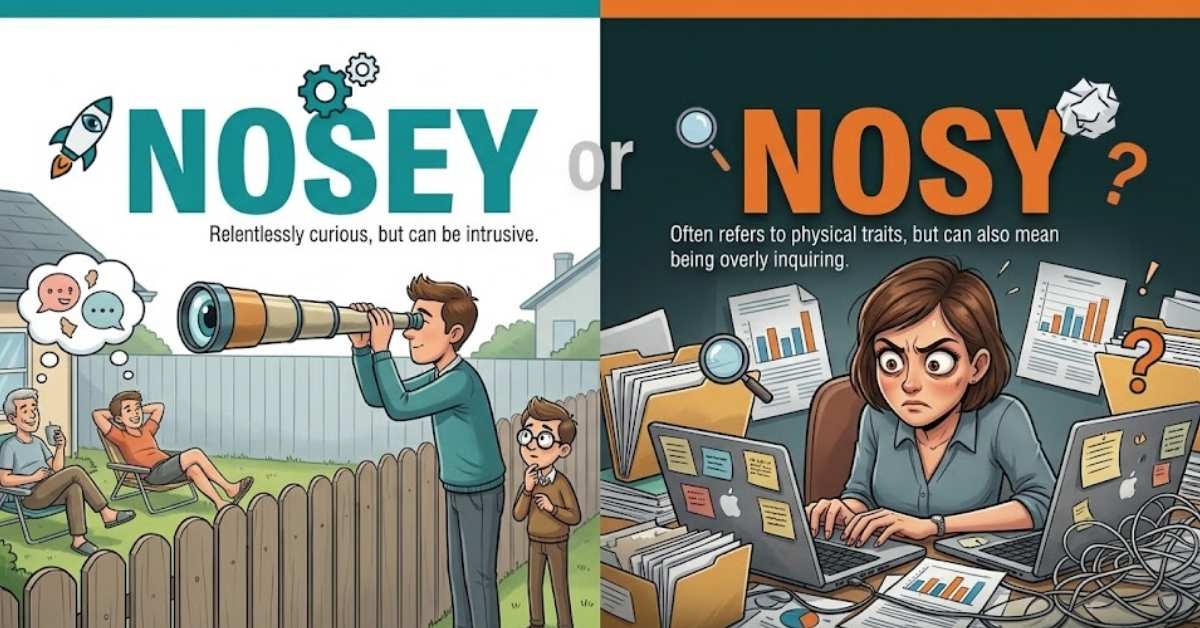
Have you ever paused while writing a simple word and wondered which spelling looks right? Nosey or Nosy can cause exactly that kind of confusion. Both spellings describe someone who takes too much interest in other people’s private lives. You might notice either version in messages, books, blogs, or social media. That makes the choice seem harder than it really is. The good news is simple: both forms are accepted. However, one spelling is more common in modern American English.
If you want your writing to look polished, knowing the difference helps. The spelling you choose can depend on your audience and writing style. You may also wonder about pronunciation, meaning, grammar, and everyday use. Don’t worry. The rule is easy to remember once you see a few clear examples. With the right guidance, you can choose the correct form confidently and avoid this common spelling mistake.
Quick Answer
Nosy or Nosey? Both spellings are correct, but nosy is the preferred spelling for most modern American English writing.
Nosey is an accepted alternative spelling. It has the same basic meaning when used as an adjective.
- Nosy: preferred spelling
- Nosey: alternative spelling
- Meaning: overly interested in other people’s private business
- Pronunciation: both spellings are pronounced the same
For formal writing, professional writing, academic writing, and school writing, nosy is usually the safer choice. It looks familiar and follows common modern usage.
For example:
“My neighbor is always nosy about my personal life.”
So, if you’re unsure which version to choose, use nosy.
Simple Examples
The easiest way to understand Nosey or Nosy is to see both spellings in context.
Both adjectives describe someone who asks too many personal questions or interferes in matters that don’t concern them.
- “My nosy neighbor asked about my salary.”
- “That nosey coworker wanted to know everything.”
- “Stop being so nosy.”
- “Her nosey questions made everyone uncomfortable.”
The meaning stays essentially the same.
Consider this conversation:
Alex: “Why did your neighbor ask where you were last night?”
Sam: “He’s just nosy.”
You could replace nosy with nosey without changing the basic meaning.
However, nosy generally looks more natural in modern American English. That’s especially true in professional writing, school writing, and everyday digital writing.
Quick Tip
Here’s the simplest rule for Nosey or Nosy: choose nosy when you need the standard modern spelling.
You don’t need to treat nosey as a spelling error. Dictionaries recognize it as an alternative form.
Think of it like other spelling variations, such as grey or gray, cancelled or canceled, and traveller or traveler. Different forms can exist without changing the core meaning.
- Use nosy for general writing.
- Use nosey when preserving someone’s preferred spelling or character voice.
- Follow your editor’s style guide when one applies.
- Keep your spelling consistent throughout the same piece.
For most readers, nosy creates the fewest questions.
Grammar Rules Explained
Nosy and nosey function mainly as adjectives. They describe someone who shows too much interest in other people’s affairs.
The adjective usually carries a negative tone. Someone can be curious without being nosy.
For example:
“Mia is curious about the new restaurant.”
That sounds neutral.
“Mia is nosy about her coworker’s divorce.”
That sounds critical because the subject feels private.
The word can describe people, questions, behavior, or habits.
- a nosy neighbor
- a nosy coworker
- nosy questions
- nosy behavior
- a nosy relative
Grammar rules don’t create a major difference between the two spellings. The main issue involves spelling preference and context.
Meaning of Nosy and Nosey
Nosy means excessively interested in other people’s private affairs.
Nosey has essentially the same meaning. Dictionaries recognize it as an alternative spelling rather than an entirely different word.
Someone who’s nosy might ask about your income, relationship, plans, family, or private conversations.
The word usually suggests more than simple curiosity.
Compare these examples:
“I’m curious about your new job.”
This can sound friendly.
“I’m nosy about your new job.”
This suggests unwanted curiosity.
Related words include inquisitive, interfering, meddling, intrusive, and prying. However, they don’t always carry exactly the same strength or meaning.
Inquisitive can sound positive. Intrusive sounds considerably more negative.
Why Two Spellings Exist
The Nosey or Nosy confusion exists because English often keeps multiple spellings for the same word.
Both versions developed around the word nose, which supplies the word’s basic origin. The image is easy to understand: someone who sticks their nose into other people’s business becomes “nosy.”
English spelling isn’t always perfectly tidy.
Consider toward or towards. Both forms occur in English. Likewise, gray or grey can differ by regional preference.
The same principle helps explain nosy and nosey.
The spelling with -ey feels visually connected to nose. Meanwhile, nosy has become the more common modern form in many contexts.
Neither spelling creates a completely different adjective.
Preferred Modern Usage
For most readers, nosy is the best default.
It appears as the main spelling in major dictionaries, while nosey appears as an accepted alternative. That makes nosy a practical choice when you don’t have a specific style guide to follow.
Use nosy in:
- professional writing
- academic writing
- school assignments
- blog writing
- general digital writing
- everyday American English
Nosey still has legitimate uses.
For example, fiction writers may choose it to match a character’s voice or a particular publication’s style.
The key isn’t to label one form “real” and the other “fake.” The more useful distinction is preferred spelling versus alternative spelling.
Why People Make Mistakes With Nosy or Nosey
Spelling confusion happens naturally when two words look and sound almost identical.
Nosey or Nosy creates exactly that problem. Both spellings represent the same basic pronunciation and meaning.
People also encounter the two forms in different places. A dictionary may show one as the main entry, while a novel, website, or social media post uses the other.
Informal writing makes the confusion even stronger.
There isn’t a dramatic grammar rule that separates the forms. Instead, writers need to recognize that English permits the variation.
Once you know that nosy is preferred and nosey is acceptable, the choice becomes much easier.
Same Pronunciation
One major reason for the confusion is pronunciation.
Nosy and nosey are pronounced the same in ordinary English speech. Adding the extra e doesn’t create a new sound.
That means you can’t rely on your ears to choose the spelling.
Imagine hearing someone say:
“She’s really nosy.”
You wouldn’t know whether the speaker imagined nosy or nosey.
The same thing happens with many English spelling pairs. Sound doesn’t always reveal spelling.
That’s why visual familiarity matters.
When you’re writing, remember that nosy is the shorter and more widely preferred form. If you’re checking a formal document, consult a dictionary or your organization’s style guide rather than guessing from pronunciation.
Visual Logic
The spelling nosey looks logical because it connects visually with nose.
After all, the word describes someone who figuratively sticks their nose into other people’s business.
That connection can make nosey feel more natural.
However, English spelling often removes or changes letters when forming related words. The shorter nosy has become an established spelling in its own right.
This is similar to other spelling variations.
For example, people may encounter grey or gray depending on regional usage. Neither form looks inherently impossible.
The same principle applies here.
“That nosy neighbor knows everybody’s business.”
The spelling may look less directly connected to nose, but it remains perfectly natural.
Exposure to Both Spellings
You may have seen nosy in one place and nosey somewhere else.
Perhaps a school textbook used nosy. A British novel used nosey. Then a social media post used nosy again.
That mixed exposure creates uncertainty.
Online communities make this especially common. Digital writing moves across countries instantly, so American English and British English forms often appear side by side.
A reader may therefore wonder:
“Did I learn the wrong spelling?”
Probably not.
You’ve simply encountered two accepted forms.
The important lesson is consistency. Pick the spelling that suits your audience and keep using it throughout the same article, story, or assignment.
Lack of Clear Teaching
Many spelling lessons focus on words with one obvious accepted form.
Nosy or Nosey doesn’t fit that neat pattern.
Students may hear that nosy is correct without learning that nosey also exists. Later, they encounter the alternative and assume someone made a mistake.
A clearer explanation teaches both facts:
- Nosy is the preferred modern spelling.
- Nosey is an accepted variant.
- Both forms share the same basic adjective meaning.
- Context can influence which form appears.
That explanation prevents unnecessary confusion.
It also teaches a broader lesson about English. Dictionaries record real usage, while editors and publishing standards often choose one preferred form for consistency.
Informal Writing Habits
Informal writing creates another layer of confusion.
People often type quickly in texts, chats, comments, and social media posts. They rarely stop to consult a dictionary.
That doesn’t mean every informal spelling is acceptable in formal work.
If a friend writes:
“Why are you so nosey lol?”
the spelling isn’t likely to cause communication problems.
However, a school assignment or professional report needs more deliberate word choice.
In formal writing, nosy is the safer option for a general American audience.
Informal writing allows more flexibility, especially when dialogue or character voice matters.
Nosy or Nosey in Real Life Usage
Words become easier to understand when you see where people actually use them.
Nosy appears in everyday conversations about personal boundaries. People commonly describe neighbors, coworkers, relatives, reporters, and strangers as nosy.
The word can sound playful, annoyed, teasing, or openly critical depending on context.
For example, calling a close friend “nosy” may be humorous.
Calling a stranger “nosy” can sound confrontational.
Nosey can appear in the same situations because it functions as an alternative spelling.
The context doesn’t change much. What changes most is the writer’s spelling preference and, occasionally, the regional or stylistic flavor.
Daily Conversation
In daily conversation, nosy usually describes someone who asks questions that feel too personal.
You might use it when talking about a neighbor, relative, friend, or coworker.
Jordan: “Why did your aunt ask how much your apartment costs?”
Alex: “She’s always been nosy.”
The word often carries a light edge of annoyance.
Sometimes, however, speakers use it playfully:
“Don’t be nosy. You’ll find out tomorrow!”
In casual speech, either nosy or nosey can represent the word. Since people hear the same pronunciation, spelling only becomes visible when someone writes it.
For everyday American English, nosy remains the natural default.
Emails
Emails require more attention to tone than casual conversation.
If you’re writing to a friend, nosy can sound perfectly natural:
“Sorry for all the nosy questions!”
A professional email requires more judgment.
Calling a client or colleague “nosy” may sound rude, even when technically accurate.
Instead, professional writing might describe the behavior more neutrally:
“The questions became increasingly personal.”
If you do use the word, nosy is generally the safer spelling.
A style guide may also influence the preferred form. When an editor or workplace has established publishing standards, consistency matters more than personal preference.
Social Media
Social media gives both spellings plenty of room to appear.
Posts, comments, captions, and online communities tend to favor conversational language. That’s where you’ll often see phrases such as:
- “My neighbors are so nosy.”
- “Don’t be nosey.”
- “Why are people so nosy?”
- “Stop asking nosy questions.”
Because social media crosses national boundaries, American English and British English usage can mix freely.
For your own posts, nosy is a simple choice.
However, if you’re quoting someone, changing nosey to nosy may remove part of their original voice.
Books and Storytelling
Fiction gives writers more freedom with spelling choices.
A character might say:
“Quit being so nosey!”
That spelling could help preserve the voice or style the author wants.
In storytelling, consistency matters. If a character repeatedly uses informal language, an editor may retain certain stylistic choices to maintain authenticity.
Character voice can matter more than rigid uniformity.
However, narration usually benefits from a consistent house style. If the publisher prefers nosy, editors may standardize it throughout the manuscript.
So, in fiction writing, nosey isn’t automatically wrong. Context and editorial standards matter.
Professional Writing
Professional writing favors clarity and consistency.
Reports, workplace documents, onboarding materials, business blogs, and official communications should usually choose nosy if the word is necessary.
Still, consider tone before using it.
“The employee was nosy.”
That sounds blunt.
“The employee asked several questions about private matters.”
That sounds more neutral and professional.
The spelling question comes second.
Professional writing should first ask whether nosy fits the message at all. If it does, the modern preferred spelling is generally the safest choice.
British and American English Usage

Regional English can explain why readers encounter different spellings.
American English commonly favors nosy, while British English also uses nosey. Both spellings remain understandable across English-speaking regions.
British English also has some informal uses of nosy that differ grammatically from the usual adjective.
This illustrates why dictionary labels matter.
Instead of treating one spelling as universally correct, consider your audience, publication, and style guide.
For American readers, nosy will usually feel familiar and straightforward.
American English
In American English, nosy is the preferred spelling for general use.
You’ll commonly see it in conversation, blogs, social media, workplace discussions, and general nonfiction.
Examples include:
“My nosy neighbor keeps asking about my weekend.”
“That reporter was getting nosy.”
“Don’t be nosy about their relationship.”
For academic writing, the word may be less common because writers often choose more precise language. Still, nosy is grammatically valid.
If an American editor asks for standard modern usage, nosy is the sensible choice.
British English
British English uses both nosy and nosey.
The alternative spelling can appear naturally in British writing, particularly informal contexts.
British English also uses nosy as an informal noun in expressions such as:
“Have a nosy around the new shop.”
Here, nosy doesn’t describe a person. It means a look or inspection.
That distinction makes British usage especially interesting.
So, when comparing Nosey or Nosy, avoid claiming that British writers exclusively use one form. Real usage is more varied.
The spelling choice becomes simple once the main distinction is clear.
Nosy is the preferred spelling for most modern American English writing. Nosey is an accepted alternative spelling with the same basic adjective meaning.
British English uses both forms, while regional and stylistic preferences can influence which one appears.
The best approach is practical:
- Choose nosy for general modern writing.
- Recognize nosey as a legitimate variant.
- Follow a publication’s style guide when required.
- Preserve the original spelling in quotations when appropriate.
- Stay consistent within your own writing.
In short, Nosey or Nosy isn’t a battle between right and wrong. It’s mainly a question of preferred spelling and context.
Which One Should You Use
For most situations, choose nosy.
It’s the preferred modern spelling and the safer option for American English. It works naturally in casual writing, professional writing, blog writing, school writing, and general digital content.
Use nosey when you have a specific reason.
For example, you might preserve it in a quotation, follow a British publication’s house style, or use it intentionally in fiction writing.
Think about your audience first.
“My nosy coworker asked about my salary.”
That sentence works well for general readers.
If you’re writing for a specific publication, check its style guide. Editors may have established preferences for spelling variants.
The goal isn’t to eliminate every alternative. It’s to make your writing clear, consistent, and appropriate for its audience.
Common Mistakes and Corrections
Most mistakes with Nosey or Nosy involve treating the alternative spelling as completely incorrect.
That’s too strict.
Nosey is an accepted variant. Still, nosy remains the better default for most American English writing.
Common mistakes include:
- ❌ “Nosie neighbor”
- ❌ “Nossy neighbor”
- ❌ Assuming “nosey” always means incorrect
- ❌ Switching between nosy and nosey randomly
- ❌ Using nosy when a more neutral word would suit formal writing better
Correct examples:
- “He’s a nosy neighbor.”
- “She asked a nosy question.”
- “Don’t be so nosy.”
- “The nosey character added humor to the story.”
The bigger lesson involves consistency. Choose a form deliberately instead of switching spellings from paragraph to paragraph.
Nosy or Nosey in More Sentences
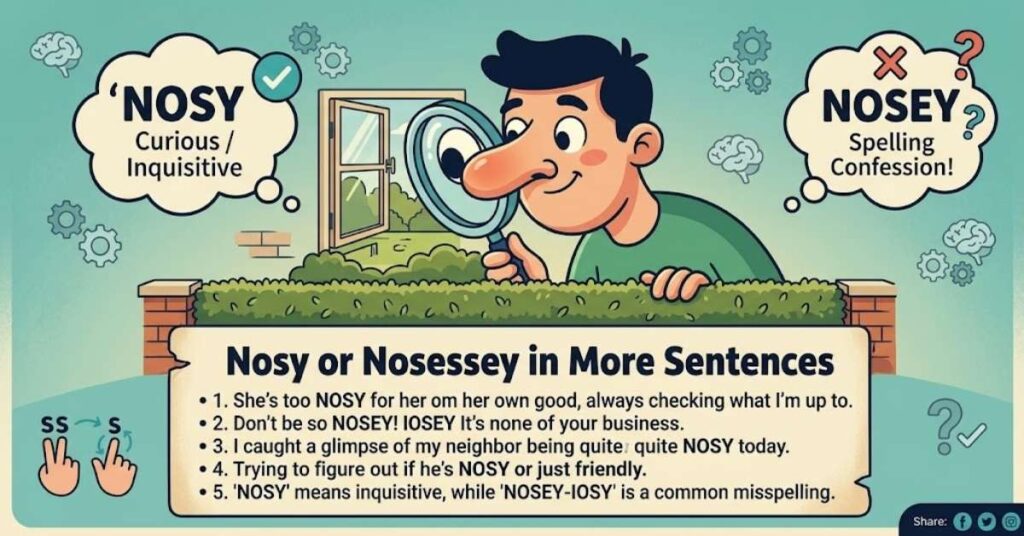
Examples make spelling decisions much easier.
The following sentences show how nosy works across different levels of writing.
Notice that the word’s tone can shift with the situation. A casual sentence may sound playful, while a formal sentence can sound critical.
The examples also show why context matters more than spelling alone.
Simple Sentences
Simple sentences make the core meaning obvious.
- “My neighbor is nosy.”
- “Don’t be nosy.”
- “She’s a nosy person.”
- “He asked a nosy question.”
- “That coworker seems nosy.”
- “Her brother is nosey.”
Each sentence describes unwanted curiosity.
For example:
“Why are you being so nosy?”
This doesn’t necessarily mean the person is malicious. It simply suggests that they’re asking questions that feel too personal.
Remember that nosey can replace nosy without changing the basic meaning.
Still, nosy remains the preferred spelling for most general American English writing.
Medium Sentences
Medium-length examples show how the word behaves in realistic situations.
- “My nosy neighbor always asks when I’m coming home.”
- “The interviewer became nosy when the conversation turned personal.”
- “Her coworker kept asking nosy questions about her relationship.”
- “The child wasn’t trying to be rude; he was simply curious.”
That final example shows an important tone difference.
Curious can sound neutral or positive. Nosy usually suggests that someone has crossed a social boundary.
“I’m curious about your new project.”
sounds friendly.
“I’m nosy about your new project.”
suggests unwanted interest.
That small difference can dramatically change the tone of a sentence.
Formal Sentences
Formal writing doesn’t often need the word nosy, but it can appear when discussing behavior.
For example:
“The report describes repeated questions as intrusive rather than merely curious.”
A more conversational version could say:
“The reporter became nosy during the interview.”
When academic writing or professional writing requires precision, terms such as intrusive, interfering, or meddling may communicate the exact behavior more effectively.
Still, if the intended tone is informal, nosy remains perfectly appropriate.
The spelling choice remains straightforward: use nosy as the preferred modern form unless a specific style requires otherwise.
Related Words and Similar Confusions
English contains many words that create spelling uncertainty.
Some involve regional preferences. Others involve contractions, doubled letters, or alternate endings.
Nosey or Nosy belongs to this wider family of spelling questions.
Learning the pattern helps you become a more confident writer. Instead of memorizing every word in isolation, notice how English allows variation while still maintaining consistency.
Read More : Ageing or Aging: Simple Rules and Examples You Need 2026
Related Words
Several words overlap with nosy, but their meanings aren’t identical.
- Curious: interested in learning or knowing something
- Inquisitive: eager to ask questions or discover information
- Intrusive: entering someone’s privacy or affairs without welcome
- Interfering: becoming involved where involvement isn’t wanted
- Meddling: interfering in another person’s affairs
- Prying: trying to discover private information
Consider the difference:
“She’s curious about the new employee.”
This sounds neutral.
“She’s nosy about the new employee.”
This sounds critical.
“She’s intrusive about the new employee.”
This sounds stronger still.
Choosing the right related word helps you control tone and meaning rather than simply adding variety.
Similar Spelling Confusions
English has plenty of spelling pairs that resemble the Nosey or Nosy issue.
Examples include:
- Grey or gray
- Cancelled or canceled
- Traveller or traveler
- Toward or towards
- Wont or won’t
- Etc. or “ect”
Some differences come from regional standards. Others involve grammar or common misspellings.
For example, wont and won’t don’t simply represent two spellings of the same word. The apostrophe changes the meaning.
Likewise, ect is generally a misspelling of etc.
Understanding the type of variation prevents false comparisons.
Why Nosy Became More Popular
The growing preference for nosy doesn’t require a complicated explanation.
Modern dictionaries generally present nosy as the main form, while nosey appears as an alternative. Editors and publishers often follow these established conventions.
Usage also changes over time.
The shorter spelling has become highly familiar in American English, which reinforces its presence in modern writing.
However, it’s better to avoid claiming that one simple factor caused the change. Language develops through many overlapping influences.
Shorter Spellings Win
Shorter spellings often feel convenient, especially in fast-moving digital writing.
Nosy removes one letter without changing pronunciation or meaning.
That makes the form visually compact.
However, spelling length alone doesn’t determine which word becomes standard. Historical usage, dictionaries, editors, readers, and publishing standards all play roles.
Consider words such as toward and towards. Both remain established forms despite their different endings.
So, while nosy looks streamlined, its popularity reflects broader language usage rather than a simple “shorter is always better” rule.
Dictionary Preference
Dictionaries help readers understand which forms are established.
Major dictionaries list nosy and recognize nosey as an alternative. That distinction matters because it separates accepted variation from outright misspelling.
A dictionary entry can therefore answer two different questions:
- Does this form exist?
- Which form does the dictionary prefer as its main entry?
For Nosey or Nosy, those aren’t identical questions.
The useful takeaway is simple: nosy is the preferred spelling, while nosey remains a recognized alternative.
That makes a dictionary much more reliable than a random online spelling opinion.
Publishing Standards
Editors often need consistent spelling across an entire publication.
A newspaper, magazine, website, or book publisher may choose nosy as its house spelling.
That doesn’t necessarily mean the editor considers nosey incorrect. The publication may simply follow a style guide that favors one form.
Consistency helps readers move through text without noticing unnecessary variations.
For professional writing, follow the relevant editorial policy whenever one exists.
If no policy applies, nosy provides a sensible modern default for American readers.
Digital Writing
Digital writing has changed how quickly spelling choices spread.
A word can move from a British blog to an American social media post within seconds. Online communities regularly mix regional forms.
That means readers may encounter nosy and nosey side by side.
Digital writing also favors familiar, compact forms. Nosy fits naturally into short posts, captions, comments, and messages.
Still, speed shouldn’t replace accuracy when the context matters.
For professional websites, blogs, and business content, choose the spelling deliberately and use it consistently.
Tone and Context Differences
The spelling itself doesn’t create a major difference in dictionary meaning.
However, nosy and nosey can create subtle tone differences because readers may associate each spelling with different regions or writing styles.
The meaning usually remains the same.
Context does most of the work.
A playful social media caption may make either form sound harmless. A workplace complaint can make the same adjective sound sharply critical.
Nosy
Nosy is the preferred spelling in most modern American English contexts.
It feels familiar, straightforward, and natural.
“My nosy neighbor knows everyone’s business.”
The word usually carries a negative or teasing tone.
You can soften it through context:
“Don’t be nosy! It’s supposed to be a surprise.”
You can also strengthen it:
“His constant nosy questions crossed a boundary.”
The surrounding words determine how harsh the statement feels.
Nosey
Nosey means essentially the same thing when used as an adjective.
Its extra e doesn’t create a separate definition.
Some readers may associate it more strongly with British English or informal writing. Others may simply regard it as an alternative spelling.
For fiction writing, nosey can also help preserve a character’s voice if that spelling fits the intended setting or style.
The key is consistency.
If a story chooses nosey, switching randomly to nosy later can make the manuscript look poorly edited.
Practice Exercises
Practice can turn a confusing spelling choice into an automatic one.
The exercises below focus on choosing between nosy and nosey while also testing context and tone.
Remember that both spellings can be valid. For general American English, however, nosy is the preferred choice.
Fill in the Blanks
Choose nosy or nosey in each sentence.
- My ______ neighbor keeps asking about my visitors.
- Don’t be so ______ about their private conversation.
- The character is intentionally written as a ______ relative.
- Her ______ questions made the interview uncomfortable.
- The children became ______ when they heard the adults talking.
Answers:
- nosy
- nosy
- nosy
- nosy
- nosy
These answers use the preferred modern spelling.
Nosey could also work in the adjective examples because it remains an accepted alternative.
Read More : Dreamed or Dreamt: Powerful Tips to Choose Right 2026
Choose the Correct Word
Choose the option that best fits general American English writing.
1. “My neighbor is very ______.”
- A. nosy
- B. nosey
Answer: A. Nosy is the preferred spelling.
2. “Don’t ask such ______ questions.”
- A. nosy
- B. nosey
Answer: A. Nosy is the preferred spelling.
3. “The character says, ‘Stop being ______!’”
- A. nosy
- B. nosey
Answer: Either can work. Character voice may influence the choice.
The exercise highlights an important point: preferred doesn’t mean exclusive.
Writing Tips to Remember the Correct Spelling
Remembering nosy becomes easier when you connect it with your usual writing habits.
The simplest approach is to treat nosy as your default form. Then recognize nosey when you encounter it elsewhere.
You don’t need to mentally “correct” every occurrence.
Instead, learn the distinction between preferred usage and acceptable variation.
Use the Shorter Version
When you’re unsure, choose nosy.
It’s shorter, familiar, and widely preferred in modern American English.
Think of the choice this way:
Nosy = default
Nosey = accepted alternative
That tiny mental rule can save you from second-guessing yourself.
It also works well for school writing, blog writing, professional content, and everyday digital writing.
Think of Digital Writing
Digital writing moves quickly.
Readers often scan articles, posts, emails, and comments rather than studying every word. Familiar spelling makes reading smoother.
Because nosy appears frequently in modern digital content, it makes a practical default.
That doesn’t make nosey wrong.
It simply means nosy is less likely to distract a general American reader.
When writing online, clarity and consistency should guide the choice.
Stay Consistent
Consistency matters more than constantly switching between variants.
If an article starts with nosy, keep using nosy unless there’s a deliberate reason to preserve nosey.
The same rule helps with other spelling choices.
A document that alternates between grey and gray without reason can look inconsistent. The same applies to nosy and nosey.
Editors notice these details because consistency makes writing feel polished.
Follow Common Usage
When no special style guide applies, follow common modern usage.
For American English, nosy is the sensible default.
If a publisher, teacher, editor, or organization has its own style guide, follow that preference instead.
The goal isn’t to prove that one spelling is superior in every situation.
Good writing considers the audience, context, tone, and publishing standards before making small language choices.
Extra Real Life Examples
Real-life examples reveal how much tone matters.
Calling someone nosy can sound playful between friends, mildly critical among coworkers, or harsh in a formal complaint.
The spelling remains largely the same. The social context changes everything.
These examples show how Nosey or Nosy can work across everyday situations.
Workplace
Workplaces often involve sensitive information, so nosy can describe uncomfortable questions.
“My coworker keeps asking how much I earn.”
“That feels a little nosy.”
During an interview, however, asking personal questions isn’t automatically nosy. Some questions may have a legitimate professional purpose.
The same distinction matters during onboarding. A new employee might ask about company procedures, which is normal curiosity.
Asking about another employee’s private relationship may feel intrusive.
So, context determines whether curiosity becomes nosiness.
In professional writing, consider using intrusive or overly personal when a neutral tone matters.
Family Situations
Family situations can produce plenty of playful nosiness.
A relative might ask:
“When are you getting married?”
Another might immediately follow with:
“How much did your house cost?”
Someone may laugh and say:
“You’re so nosy!”
Among close relatives, the word can sound teasing rather than hostile.
However, repeated questions about money, relationships, health, or private decisions can cross genuine boundaries.
That’s why curious and nosy aren’t interchangeable in every family situation.
Curiosity asks because someone wants to know. Nosiness suggests that the person may not respect the boundary.
Online Communities
Online communities create a unique environment for nosy behavior.
People can ask strangers about relationships, income, family problems, or private decisions without seeing the immediate reaction.
A comment such as:
“Why did you two break up?”
may receive a playful answer.
Another user might respond:
“That’s a little nosy.”
Social media makes these tone differences especially important.
Written comments don’t carry facial expressions or vocal cues, so a supposedly harmless question can sound intrusive.
Whether you choose nosy or nosey, the underlying meaning remains clear. For general American English content, nosy remains the preferred spelling.
FAQs
Is Nosey or Nosy correct?
Both Nosey or Nosy spellings are accepted, but nosy is generally preferred in modern American English writing today.
Is nosey considered a misspelling?
No, nosey is an accepted alternative spelling. However, Nosey or Nosy usage often favors nosy for American readers.
Which spelling is preferred in American English?
American English generally prefers nosy. When choosing Nosey or Nosy for everyday writing, nosy remains the safer option.
Do nosy and nosey have different meanings?
No, both spellings generally describe unwanted curiosity about private matters. Nosey or Nosy mainly differs in spelling preference.
How do you pronounce nosy and nosey?
Nosy and nosey normally share the same pronunciation. The Nosey or Nosy spelling difference doesn’t change their spoken sound.
Can you use nosey in formal writing?
Yes, but nosy is usually the better choice. For Nosey or Nosy questions, formal writing often favors the preferred spelling.
Is nosy more common than nosey?
Yes, nosy is generally more common in modern American usage. Nosey or Nosy comparisons usually recommend nosy as the default.
Is nosey used in British English?
Yes, British English uses both forms. Nosey or Nosy can appear depending on regional preference, publication standards, or individual style.
Can writers use nosey in fiction?
Yes, writers can use nosey in fiction. Nosey or Nosy choices may support character voice, dialogue, setting, or stylistic consistency.
How can you remember the correct spelling?
Choose nosy as your default spelling. When comparing Nosey or Nosy, remember that nosey remains an accepted alternative form.
Conclusion
Choosing between Nosey or Nosy is easier once you know the basic rule. Both spellings describe someone who shows too much interest in other people’s private matters. The main difference is spelling preference, not meaning. Nosy is the preferred form for most modern American English writing. Nosey is still an accepted alternative. You may see both forms in books, blogs, social media, and everyday conversations. So, don’t assume that nosey is automatically wrong when you come across it.
For school, professional, academic, or general writing, nosy is usually the safest choice. It looks familiar and fits common modern usage. However, Nosey or Nosy can depend on your audience, region, or style guide. British English may use both spellings. The best approach is simple. Choose one form, use it consistently, and consider your writing context. When unsure, choose nosy.
