
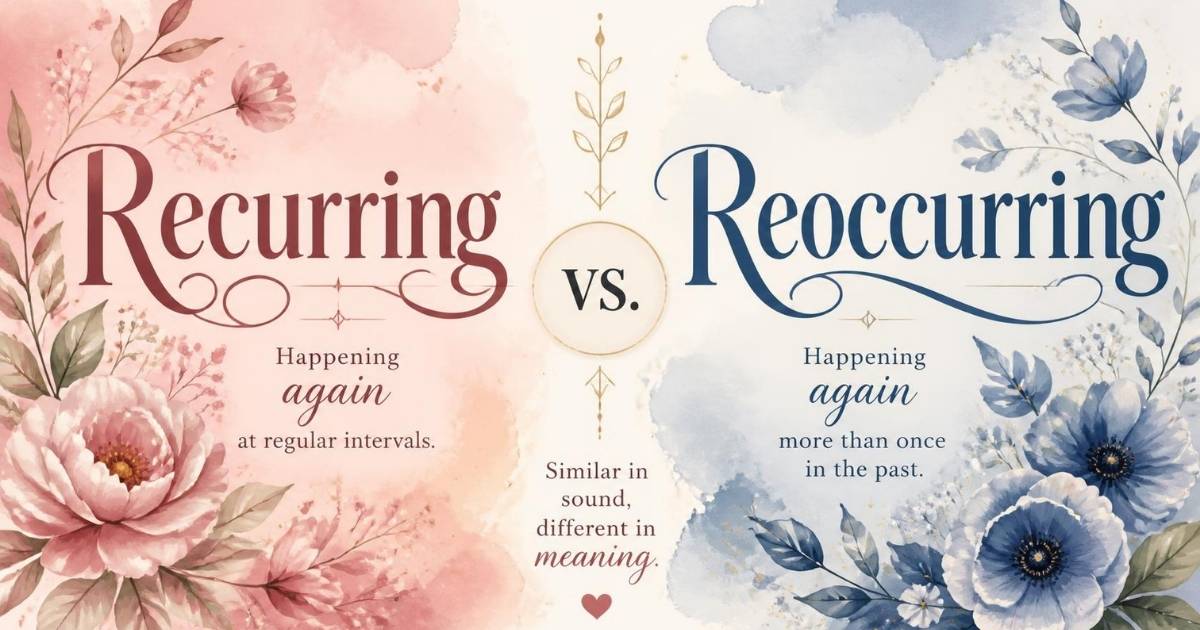
Have you ever wondered whether something that happens again is recurring or reoccurring? You’re not alone. These two words look almost identical, and both describe something happening more than once, but they don’t always carry the same meaning.
Recurring usually points to something that repeats regularly or follows a recognizable pattern, such as a monthly bill, weekly meeting, or annual event. Reoccurring, on the other hand, simply means something happens again, without suggesting a predictable schedule. A computer glitch that suddenly returns months later is a good example. Both words are correct, but knowing whether repetition is regular or simply repeated makes choosing the right one much easier.
What Do Recurring and Reoccurring Mean?
Recurring vs. Reoccurring often confuses writers because both words describe something happening again. However, they can carry slightly different ideas. Recurring usually suggests repetition with some kind of pattern, frequency, or regular schedule. Reoccurring simply points to something occurring again, even when no predictable pattern exists.
Think of the difference as the difference between a clock and a surprise. A monthly phone bill follows a set interval, while an unexpected software glitch might return without warning.
- Recurring: repeated or happening periodically
- Reoccurring: happening again
- Both words are legitimate English.
- The best choice depends on context.
Definition of Recurring
Recurring describes something that happens repeatedly, often at regular intervals or expected intervals. The word comes from the Latin recurrere, meaning “to run back.” That idea fits its modern meaning because something recurring keeps coming back.
A weekly team meeting is recurring because everyone expects it to happen again. A monthly subscription fee also follows a predictable pattern.
Common examples include:
- Recurring charge
- Gym membership
- Annual health checkup
- Recurring revenue
- Seasonal allergies
- Recurring dream
- Recurring symptoms
You can usually connect recurring with frequency, repetition, or a regular schedule. It doesn’t always require a perfectly fixed calendar date. The important idea is that the repetition feels expected or patterned.
Conversation example:
Alex: “Why did you add that payment to the budget?”
Sam: “It’s a recurring charge from my gym membership.”
Definition of Reoccurring
Reoccurring means something happens again. Unlike recurring, it doesn’t necessarily suggest a regular schedule or predictable pattern. It comes from the prefix re-, meaning “again,” combined with occur, meaning “to happen.”
Imagine a Wi-Fi issue that disappears for several weeks and suddenly returns. You can describe that problem as reoccurring because it has happened again. Yet the timing may not follow any set interval.
Examples include:
- A software glitch returning
- A server error appearing again
- A spelling error appearing repeatedly
- Flooding returning during the rainy season
- A headache returning unexpectedly
- Software reinstallation becoming necessary again
Still, don’t treat reoccurring as a synonym for “random.” The word simply doesn’t emphasize a regular pattern as strongly as recurring does.
Conversation example:
Mia: “Did the server finally stop crashing?”
Jake: “No. The same error is reoccurring.”
Recurring vs. Reoccurring: The Core Difference
The easiest way to understand Recurring vs. Reoccurring is to focus on what the repetition suggests. Recurring often points toward patterned repetition, while reoccurring focuses more broadly on something happening again.
For example, a weekly team meeting is clearly recurring because it follows a regular schedule. A software glitch that appears again after several months may be described as reoccurring.
| Word | Main idea | Typical clue |
| Recurring | Repeated occurrence | Pattern or frequency |
| Reoccurring | Occurring again | Another occurrence |
| Recurring payment | Expected repetition | Set interval |
| Reoccurring problem | Happens again | Pattern may be unclear |
The distinction isn’t absolute. In everyday English, people sometimes use these words interchangeably.
The Frequency and Pattern Factor
Frequency gives recurring much of its practical meaning. When something happens periodically or at expected intervals, recurring often sounds more natural.
A monthly phone bill provides an obvious example. You expect the charge every month, so it follows a predictable pattern. The same applies to an annual fee, weekly meeting, or annual health checkup.
Reoccurring doesn’t necessarily carry that same rhythm. Something can happen again without following a timetable. A sudden server error may return after an unknown amount of time.
Consider these ideas:
- Recurring: scheduled repetition
- Recurring: patterned repetition
- Reoccurring: repetition without rhythm
- Reoccurring: an irregular pattern
- Recurring: regular intervals
- Reoccurring: another occurrence
However, context matters. A recurring headache doesn’t have to appear at exactly 8 a.m. every Monday. The broader idea is repeated occurrence.
Read More : What Does Fidelity Mean? Complete Guide with Example 2026
A Simple Rule to Remember the Difference
Try the calendar test when you’re unsure which word to choose. Ask yourself whether you could reasonably expect the event to appear on a calendar or schedule.
If the answer is yes, recurring will often be the better choice. A weekly meeting, monthly subscription fee, or annual health checkup all fit this pattern.
If something simply happened again without a clear timetable, reoccurring may fit better.
Quick memory trick:
- Recurring = comes back with a pattern
- Reoccurring = occurs again
- Regular schedule = recurring
- Unexpected return = potentially reoccurring
Conversation example:
Nina: “Should I call this a recurring problem?”
Omar: “If it keeps happening in a recognizable pattern, yes.”
Nina: “What if it just happened again?”
Omar: “Reoccurring can describe that.”
Remember, this is a useful guide rather than an unbreakable grammar rule.
Real-World Examples of Recurring and Reoccurring
Real examples make the distinction much easier to recognize. Recurring usually works well when repetition feels expected, scheduled, or patterned. Reoccurring works when you’re mainly emphasizing that something has happened again.
For instance, your monthly phone bill is recurring because you expect it every month. A recurring dream also returns repeatedly, even though it may not follow a strict schedule.
Meanwhile, a Wi-Fi issue can be reoccurring if it suddenly returns after being fixed. A software glitch can also be described this way when it appears again without a clear pattern.
The surrounding context matters more than memorizing a rigid formula.
Compare:
- Recurring revenue → expected income pattern
- Recurring themes → repeated ideas
- Reoccurring server error → error happens again
- Reoccurring flooding → flooding returns
Recurring in Everyday Use
You encounter recurring situations constantly. Many everyday events repeat often enough that you can anticipate them. That’s why recurring naturally works with bills, appointments, habits, symptoms, meetings, and seasonal events.
Consider your gym membership. The payment may appear every month, creating a recurring charge. Likewise, seasonal allergies can become recurring because they return during particular times of the year.
Other familiar examples include:
- A monthly phone bill
- A weekly team meeting
- An annual health checkup
- A recurring reminder
- A recurring dream
- Recurring back pain
- Recurring themes in a story
Conversation example:
Chris: “Why does this reminder keep appearing?”
Taylor: “It’s a recurring reminder. You set it to repeat every Monday.”
The key idea is repetition that feels expected, patterned, or established.
Reoccurring in Everyday Use
Reoccurring can describe an event or problem that happens again. The word becomes especially useful when you don’t want to emphasize a fixed schedule.
Imagine fixing a Wi-Fi issue only to discover the same problem several weeks later. The problem has reappeared. You might call it a reoccurring issue because it occurred again.
Consider these situations:
- A software glitch returns
- A server error appears again
- A spelling error shows up again
- Flooding returns after heavy rain
- A headache comes back unexpectedly
- A data breach risk appears again
Conversation example:
Liam: “Didn’t we fix this software glitch?”
Noah: “We did, but it’s reoccurring.”
Here, the speaker emphasizes the return of the problem rather than a fixed frequency. In many contexts, recurring could also work. The choice depends on the nuance the writer wants to communicate.
When to Use Recurring vs. Reoccurring in Writing
Choosing between these words becomes easier when you focus on the meaning you want your reader to notice. Use recurring when repetition, frequency, or an established pattern matters. Use reoccurring when you mainly mean that something has happened again.
For example, recurring revenue sounds natural in financial reports because businesses receive that income repeatedly. Recurring symptoms also works well in medical documentation when symptoms return over time.
On the other hand, you might describe a problem as reoccurring when it appeared again after a previous solution.
Read More : What Does HU Mean in Text? Powerful 2026 Guide
Writing guide:
- Patterned repetition → recurring
- Regular schedule → recurring
- Repeated theme → recurring
- Another occurrence → reoccurring
- Unclear frequency → reoccurring may fit
- Both meanings possible → consider recurring first
The words overlap, so don’t force a distinction when context doesn’t require one.
Using Recurring in Professional and Formal Writing
Recurring is especially common in business writing, professional emails, financial reports, project management, and formal writing. It clearly communicates repeated activity without making the sentence harder to understand.
Businesses regularly discuss recurring revenue, recurring expenses, and recurring charges. Project managers might create recurring tasks or schedule recurring meetings. Editors may also prefer recurring when describing a repeated idea or pattern.
Examples include:
- “The company reported strong recurring revenue.”
- “Please review the recurring monthly charge.”
- “We scheduled a recurring project meeting.”
- “The report identifies several recurring themes.”
- “The patient reported recurring symptoms.”
In academic writing, recurring themes and recurring patterns are also natural choices. Style guides and editors generally favor familiar wording when it communicates the intended meaning clearly.
If you want a safe choice in formal writing, recurring is often the stronger option when repetition forms a pattern. It sounds precise, natural, and widely established in published English writing.
FAQs
Is reoccurring a real word?
Yes, reoccurring is a legitimate English word meaning something happens again. In Recurring vs. Reoccurring, context determines the better choice.
Can I use recurring and reoccurring interchangeably?
Sometimes, yes, because both describe something happening again. However, Recurring vs. Reoccurring often depends on whether repetition suggests pattern.
Which is more correct — recurring or reoccurring?
Neither is automatically wrong. In Recurring vs. Reoccurring, recurring usually sounds better when describing regular, repeated, or predictable events.
What is a recurring event?
A recurring event happens repeatedly, often following a schedule or pattern. Examples include weekly meetings, monthly payments, and annual appointments.
What does reoccurring mean in a medical context?
Reoccurring means a symptom, condition, or problem happens again. Doctors may also use recurring when describing repeated symptoms or health issues.
Does British English use these words differently?
British English generally uses both words similarly to American English. Recurring vs. Reoccurring usually depends on context, emphasis, and writer preference.
Conclusion
Recurring vs. Reoccurring becomes easier when you focus on the pattern. Recurring vs. Reoccurring both describe something happening again. However, recurring usually suggests repetition, frequency, or a predictable pattern. A monthly bill, weekly meeting, or annual fee is recurring. These events follow expected intervals. The word also connects to the Latin recurrere, meaning to run back. That idea helps explain why something recurring keeps coming back.
In Recurring vs. Reoccurring, reoccurring simply means happening again. It doesn’t always suggest a regular schedule. A software glitch or Wi-Fi issue can be reoccurring when it returns unexpectedly. Still, the words can overlap in everyday English. If you’re unsure, choose recurring when a repeated pattern matters. Choose reoccurring when you only mean that something happened again. This simple approach makes Recurring vs. Reoccurring easier to use correctly in everyday and formal writing.
