
Have you ever read a property document or construction plan and stopped at the word abut meaning? It may look confusing at first. The good news is that it’s much easier than it sounds. This small word has a big role in real estate, land surveying, engineering, architecture, and property law. Once you understand it, you’ll notice it in contracts, maps, blueprints, and legal papers. A simple explanation and a few everyday examples are all you need to remember it.
This guide breaks everything down into clear, simple English. You’ll learn the definition, pronunciation, grammar, and real-life uses without complicated terms. You’ll also understand the difference between abut, adjacent, and adjoining so you never mix them up again. By the end, you’ll know exactly when to use the word and why it matters in both professional documents and everyday conversations.
The Simple Definition of Abut
The abut meaning is simple. Abut means to touch, meet, or share a common boundary without overlapping. Two things abut when their edges connect directly. You’ll often see this word in property law, construction, land surveying, and architecture.
For example, two houses may abut each other if they share a property line. A wall can also abut another wall, or a road may abut a parcel of land. Unlike “overlap,” abutting objects stay separate while their edges meet.
Quick examples:
- A fence abuts your neighbor’s yard.
- The building abuts the sidewalk.
- The backyard abuts a public park.
Conversation example:
Alex: Does your lot touch the park?
Sam: Yes. My property abuts the park boundary.
What Does Abut Mean?
The abut meaning refers to two things that touch along a shared edge or boundary. They don’t overlap or leave a gap. Instead, they meet exactly where one ends and the other begins. The word appears in everyday property discussions and technical fields like engineering and surveying.
You might hear someone say that a house abuts another property or that a bridge abutment supports the end of a bridge deck. The meaning stays the same across different situations. It always describes direct contact between two surfaces, structures, or pieces of land.
Common uses:
- Abutting property
- Abutting land
- Abutting walls
- Bridge abutment
Conversation example:
Buyer: Does this lot border the highway?
Agent: Yes. It abuts the state highway.
How to Pronounce Abut Correctly
abut (uh-BUT)
Knowing the correct pronunciation makes the abut meaning easier to remember. The word is pronounced “uh-BUT.” The stress falls on the second syllable. It rhymes with words like “cut” in the final sound.
Pronunciation tips:
- Say “uh” first.
- Stress “BUT.”
- Keep the sound smooth and natural.
Word forms:
- Abut
- Abuts
- Abutted
- Abutting
- Abutment
Conversation example:
Student: Is it “AY-but”?
Teacher: No. Say “uh-BUT.” That’s the correct pronunciation.
Abut vs Adjacent vs Adjoining: Stop Confusing Them
Many people mix up these words. Understanding the difference helps you use the abut meaning correctly. Abut means two things actually touch. Adjacent means something is nearby but may not touch. Adjoining usually means two properties or structures touch and share a common boundary.
| Term | Meaning |
| Abut | Touch directly along a boundary |
| Adjacent | Near each other but not always touching |
| Adjoining | Touching and sharing a boundary |
Easy examples:
- Two lots abut each other.
- A coffee shop is adjacent to the library.
- Two hotel rooms are adjoining with a shared wall.
Conversation example:
Owner: Is the vacant lot adjacent?
Surveyor: It actually abuts your parcel because both share the same boundary line.
Abut in Real Estate and Property Law
The abut meaning is especially important in real estate and legal documents. When a parcel of land abuts another property, they share the same boundary line. This relationship can affect ownership, easements, right of way, zoning ordinances, and future development.
Surveyors use deeds, metes and bounds, tax maps, and title records to confirm whether two lots are abutting. Lawyers also rely on these details during property transfers and boundary disputes. Knowing whether land is abutting helps avoid costly mistakes and protects property rights.
Common legal terms:
- Property line
- Boundary line
- Easement
- Deed
- Parcel
- Lot
- Grantor
- Title insurance
What Does Abutting Property Mean?
Abutting property means one property directly touches another without any space between them. The two parcels share a common property line. This doesn’t mean the owners share ownership. It only means their land meets at the boundary.
An abutting owner may have certain rights or responsibilities depending on local laws. For example, shared fences, drainage easements, or access roads can affect both properties.
Examples:
- Two homes share one boundary line.
- A business lot abuts a residential district.
- A farm abuts a public road.
Conversation example:
Buyer: Does this land touch the river?
Agent: Yes. The property abuts the riverbank.
Legal Language You Will See
Legal documents often use technical words alongside the abut meaning. These terms explain ownership, access, and property boundaries. You’ll frequently find them in deeds, surveys, zoning records, and court documents.
Common legal terms include:
- Easement
- Right of way
- Ingress and egress
- Metes and bounds
- Parcel
- Grantor
- Cloud on title
- Zoning ordinance
- Tax assessor
- Title insurance
Understanding these terms makes legal documents much easier to read.
Why Abutting Matters for Property Rights
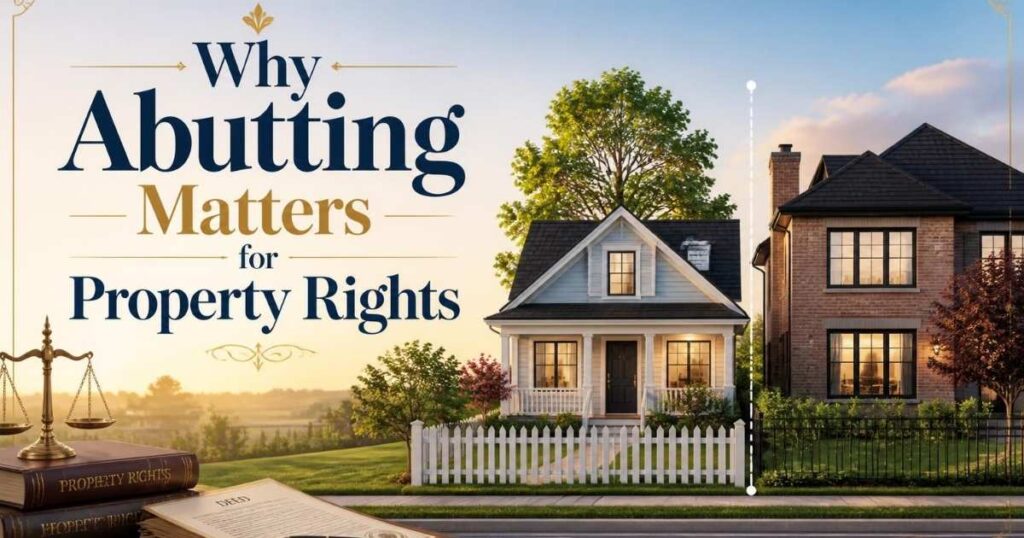
Whether land abuts another parcel can affect your legal rights. Shared boundaries may influence fencing, utility access, road connections, and drainage easements. Local zoning rules may also change what you can build.
If questions arise, a licensed surveyor can confirm the exact boundary. Accurate records help prevent disputes and protect both property owners.
It may affect:
- Building permits
- Easements
- Property access
- Utility lines
- Fence placement
Read More : What Does a White Heart Mean? Ultimate Guide 2026
Abutting Land vs Adjacent Land in Tax Records
Tax records often distinguish between abutting land and adjacent land. Abutting land shares a direct boundary. Adjacent land may simply be nearby and separated by a road, buffer zone, or another parcel.
Tax assessors, surveyors, and local governments rely on this distinction when preparing tax maps and ownership records.
| Abutting Land | Adjacent Land |
| Shares a boundary | May not touch |
| Direct contact | Nearby location |
| Common property line | Possible separation |
Abut in Construction and Architecture
In construction, the abut meaning describes materials or structures that meet perfectly at their edges. Builders use this concept when reading a blueprint, installing partition walls, building retaining walls, or creating clean material joinery.
Good planning ensures that surfaces fit together correctly without unwanted gaps or overlap. Whether working with concrete, wood, steel, or stone, proper alignment improves strength, appearance, and safety.
Construction examples:
- Walls abut each other.
- Trim abuts the ceiling.
- A retaining wall abuts the roadway.
- Concrete panels abut at expansion joints.
Abutting Walls
Abutting walls touch each other along a shared edge. They don’t overlap, and neither wall passes through the other. Architects often design partition walls and shear walls to meet this way.
Builders may use caulk or trim where walls meet to create a clean finish and seal small gaps.
Conversation example:
Contractor: Should these walls overlap?
Engineer: No. They should abut neatly along the grid line.
Abutment in Bridges
A bridge abutment is a structure that supports each end of a bridge deck. It transfers the bridge’s weight into the ground and often works with a retaining wall to hold back soil.
Departments of Transportation carefully design bridge abutments to improve stability, drainage, and long-term safety.
Bridge components:
- Bridge deck
- Bridge abutment
- Retaining wall
- Culvert
- Grade line
Abutting in Material Joinery
In woodworking and construction, materials often abut to form clean connections. Builders may create a simple butt joint or use stronger methods like a mortise and tenon or dovetail joint, depending on the project.
A precise fit improves strength and appearance while reducing gaps that could weaken the structure.
Examples:
- Wood panels abut before fastening.
- Floorboards abut without overlapping.
- Trim pieces meet with a clean butt joint.
- Cabinet parts connect using a mortise and tenon.
Abut in Land Surveying
The abut meaning plays an important role in land surveying. Surveyors use the word when two parcels, lots, or properties touch along the same boundary line. They don’t overlap, and they don’t leave a gap. Instead, they share a common edge.
Accurate surveys help prevent property disputes. A licensed surveyor measures land using legal descriptions, maps, and boundary markers. The final survey confirms whether one parcel abuts another. These details also appear in deeds, title records, and tax maps.
Surveyors often check:
- Property line locations
- Boundary monuments
- Parcel corners
- Lot dimensions
- Neighboring land
- Easements
Conversation example:
Owner: Do our lots touch?
Surveyor: Yes. Your parcel abuts your neighbor’s land along the eastern boundary.
What Surveyors Mean by Abutting
When surveyors say land is abutting, they mean two properties share one continuous property line. This definition has legal value because it affects ownership, access, and future development.
Surveyors use measurements instead of guesses. They compare field observations with deeds and metes and bounds descriptions. If two parcels meet exactly, they are considered abutting properties.
Survey documents may include:
- Parcel numbers
- Boundary line measurements
- Survey markers
- Property corners
- Tax map references
Conversation example:
Buyer: Does this lot border mine?
Surveyor: Yes. Both parcels are abutting properties.
Abutting Roads and Rights of Way
The abut meaning also applies when land touches a public road or highway. If your property directly borders the road, it is an abutting property. This can affect access, maintenance, and future improvements.
Many roads include a public right of way. That area may belong to the local government even though it sits beside your land. Property owners should always check survey records before building fences or driveways.
Important terms:
- Right of way
- Ingress and egress
- State highway
- Fire lane
- Department of Transportation
Conversation example:
Homeowner: Can I build my fence here?
Engineer: First, confirm where the road right of way ends.
Abutting Water Bodies
Land can also abut a river, lake, canal, or coastline. In these cases, the property touches the water directly. This may influence ownership rights, land use, and environmental regulations.
Some waterfront properties include riparian rights. These rights vary by state and local law. Surveyors determine the exact boundary before any construction begins.
Examples:
- Property abuts a river.
- Land abuts a lake.
- Parcel touches a canal.
- Farm borders a stream.
Conversation example:
Buyer: Is this waterfront property?
Agent: Yes. The lot abuts the lake.
Synonyms of Abut
Understanding similar words makes the abut meaning easier to remember. Some synonyms describe direct contact, while others simply mean being nearby. Choosing the correct word depends on the situation.
For example, adjoin usually means two places touch. Adjacent often means nearby but not always connected. In construction, you may also hear butt against or join.
Common synonyms:
- Adjoin
- Adjoining
- Border
- Bordering
- Meet
- Touch
- Touching
- Connect
- Join
- Neighbor
- Butt against
Conversation example:
Student: Can I say “touch” instead of “abut”?
Teacher: Yes, in casual conversation. “Abut” sounds more formal.
Antonyms of Abut
The opposite of the abut meaning is having space, distance, or separation between two things. If objects don’t touch, they don’t abut.
Knowing these opposite words helps you avoid mistakes in legal documents, engineering plans, and everyday writing.
Common antonyms:
- Separate
- Disconnect
- Divide
- Detach
- Distance
- Gap
- Setback
- Overlap
Remember that overlap is not the same as abut. Overlapping means one object extends onto another.
Conversation example:
Builder: Should these boards overlap?
Foreman: No. They should abut with clean edges.
Read More : SPWM Meaning in Text: Complete Guide & Examples (2026)
Abut Grammar Rules and Conjugations
The abut meaning stays the same no matter which verb form you use. However, the spelling changes when adding different endings. Since abut is a regular verb, it follows standard English grammar rules.
You’ll most often see abuts, abutted, and abutting in technical writing, property documents, and engineering reports.
Verb forms include:
- Abut
- Abuts
- Abutted
- Abutting
Learning these forms helps you write clearly and avoid spelling mistakes.
Conjugation Table
| Tense | Form |
| Base verb | Abut |
| Third person | Abuts |
| Present participle | Abutting |
| Past tense | Abutted |
| Past participle | Abutted |
Example sentences:
- The fence abuts the road.
- The wall abutted the building.
- The properties are abutting each other.
The Double T Rule
The abut meaning doesn’t change when adding endings, but the spelling does. English follows the double consonant rule here. Because abut ends with one vowel followed by one consonant, you double the T before adding -ed or -ing.
Correct forms include:
- Abutted ✅
- Abutting ✅
Incorrect forms include:
- Abuted ❌
- Abuting ❌
This same rule appears in words like permit → permitted and commit → committed.
Common Grammar Mistakes
Many writers misuse the abut meaning because they confuse it with similar words.
Avoid these common errors:
- Using adjacent when things actually touch.
- Writing abuted instead of abutted.
- Using abut when objects overlap.
- Forgetting to double the final T.
Conversation example:
Editor: You wrote “abuted.”
Writer: Thanks. I’ll change it to abutted.
Abut Usage in Different Contexts
The abut meaning stays consistent across many industries. Whether you’re discussing property, construction, geography, or city planning, the idea remains simple. Two things meet along a shared edge.
Different professions use the word in different ways, but the core definition never changes.
You’ll commonly see abut in:
- Property law
- Engineering
- Surveying
- Geography
- Urban planning
- Architecture
Understanding the context helps you choose the correct meaning quickly.
Abut in Geography
In geography, abut describes places that meet along a natural or political boundary.
Examples include:
- A valley abuts a mountain range.
- One country abuts another.
- A desert borders a plain.
- A delta meets the sea.
Geographers use this word when describing landforms and regions.
Conversation example:
Student: Do these two countries share a border?
Teacher: Yes. They abut each other.
Abut in Civil Engineering
Civil engineers use the abut meaning when designing roads, bridges, retaining walls, and drainage systems. Components often meet without overlapping.
Examples include:
- Bridge abutment
- Bridge deck
- Retaining wall
- Culvert
- Highway structures
Proper alignment improves strength and safety.
Conversation example:
Engineer: Does the retaining wall meet the bridge?
Inspector: Yes. It abuts the bridge abutment.
Abut in Urban Planning
Urban planners often describe how different districts or land uses connect. A commercial district may abut a residential district, while a transit corridor may border both.
Buffer zones sometimes separate different land uses. Other times, districts share a direct boundary.
Examples:
- Historic district
- Residential district
- Commercial district
- Zoning district
- Buffer zone
Abut in Everyday Conversation
Although abut is formal, people still use its meaning in everyday life.
Instead of saying abut, many people simply say:
- Touch
- Meet
- Join
- Border
Conversation example:
Friend: Does your backyard touch the park?
You: Yes. It abuts the park fence.
The History of Abut: A Quick Etymology
The abut meaning has existed for centuries. The word comes from the Old French verb abouter, which meant “to end at” or “to touch.” English adopted the word during the 13th century. Over time, it became common in legal writing, surveying, and construction.
The related noun abutment appeared later during the 17th century. Today, both words remain important in engineering and property law.
Timeline:
- Old French: abouter
- 13th century: abut
- 17th century: abutment
Abut in Legal Documents: What to Watch For
The abut meaning appears often in legal documents because property boundaries affect ownership and land use. Lawyers use the word to describe parcels that share a common edge.
Always read boundary descriptions carefully before buying land or signing contracts.
Watch for references to:
- Deeds
- Easements
- Property lines
- Right of way
- Boundary descriptions
- Tax maps
Deed Language
A deed may state that one parcel abuts another property, a public road, or a river. This helps identify the exact location of the land.
Common deed terms include:
- Grantor
- Parcel
- Lot
- Boundary line
- Metes and bounds
Always compare the deed with a recent survey.
Easement Language
An easement gives someone the legal right to use part of another person’s property. If land abuts an easement, special rules may apply.
Common examples include:
- Utility easement
- Drainage easement
- Access easement
- Easement by prescription
Review easement language before making improvements.
Zoning Ordinance Language
A zoning ordinance controls how land can be used. Whether your property abuts another zoning district may affect building height, setbacks, parking, and permitted uses.
Always review local zoning rules before starting construction.
Examples:
- Residential district
- Commercial district
- Historic district
- Buffer zone
Abut vs Overlap: A Critical Distinction
The abut meaning and overlap describe completely different relationships. When things abut, they meet at the edge only. When they overlap, one extends over the other.
| Abut | Overlap |
| Touches at the edge | Covers part of another object |
| No shared area | Shared area exists |
| Clean boundary | Crossing boundary |
Conversation example:
Installer: Should these panels overlap?
Supervisor: No. They should abut perfectly.
Quick Reference Card for Abut
Use this quick guide whenever you need to remember the abut meaning.
| Topic | Quick Answer |
| Meaning | Touch or meet along a shared boundary |
| Part of speech | Verb |
| Noun form | Abutment |
| Present tense | Abuts |
| Past tense | Abutted |
| Present participle | Abutting |
| Opposite | Separate, detach, overlap |
| Common fields | Real estate, surveying, construction, law, engineering |
| Similar words | Adjoin, border, touch, meet, connect |
| Key idea | Touching without overlapping |
FAQs
What does abut mean in simple words for a child?
The abut meaning is when two things touch each other at the edge without leaving a gap or overlapping.
Is abut only used for land?
No. The abut meaning also applies to walls, bridges, roads, buildings, rivers, and many construction or engineering projects.
Can a house abut a street?
Yes. The abut meaning includes a house that directly touches or borders a street along its property line.
What is the difference between abutting and adjacent?
The abut meaning describes things that touch directly, while adjacent usually means nearby and may not share a boundary.
How do you use abut in a sentence about two houses?
Example: The two houses abut each other because they share the same property line without any space between them.
What is an abutting owner?
An abutting owner is someone whose property shares a boundary with another property, road, park, or public land.
Can a river abut land?
Yes. The abut meaning includes land that directly touches a river, lake, canal, or other natural water body.
Is abut a common word?
The abut meaning is common in real estate, surveying, construction, and law, but less common in everyday conversations.
Conclusion
The abut meaning is simple once you understand it. It means two things touch along a shared edge without overlapping. You will often see the abut meaning in real estate, property law, construction, architecture, land surveying, and civil engineering. Knowing the abut meaning helps you read legal documents, understand maps, and use the word correctly in everyday situations. It also makes it easier to tell the difference between abut, adjacent, and adjoining.
Learning the abut meaning can improve your vocabulary and help you avoid common mistakes. Whether a property abuts a road, a wall abuts another wall, or land abuts a river, the idea stays the same. Remember that the abut meaning always describes two things that meet at a common boundary. Keep this simple definition in mind, and you will use the abut meaning with confidence whenever you see it in books, legal papers, construction plans, or daily conversations.
