

Have you ever received a message containing VM and wondered what the sender was talking about? These two letters can have different meanings depending on the conversation. In everyday digital communication, VM meaning in chat usually refers to a voice message or voicemail. However, some people also use it when discussing video messages or technology. Understanding the difference can save you from awkward misunderstandings. For example, someone asking you to listen to a VM probably means an audio recording, while a person mentioning a missed call may be talking about voicemail. The surrounding words offer the biggest clue. This guide explains the different definitions, texting examples, social media uses, and common ways to respond. You’ll also learn when VM is appropriate and how it differs from similar communication terms.
Quick Answer: What Does VM Meaning in Chat?
VM commonly means Voice Message or Voicemail in everyday digital communication.
The intended definition depends on the situation. When someone discusses sending or listening to recorded audio in a messaging app, VM usually means voice message.
However, when the conversation involves missed calls or telephone systems, it generally refers to voicemail.
Here are the most common meanings:
| VM Meaning | Context | Example |
|---|---|---|
| Voice Message | Texting and online chats | Send me a VM. |
| Voicemail | Phone conversations | I left you a VM. |
| Video Message | Video-related conversations | Send me a VM. |
| Virtual Machine | Computing and technology | Run it inside a VM. |
The easiest way to understand this abbreviation is to consider what the conversation is about.
What Does VM Stand For?
VM can represent several phrases, but its meaning changes with the topic. Here are four common interpretations.
1. Voice Message
Voice message is one of the most common meanings of VM in texting.
It refers to an audio recording that someone sends through a messaging application instead of typing everything. You can record your voice, share the audio, and let another person listen whenever convenient.
For example:
- I sent you a VM. Check it out!
- Can you send me a VM instead?
- Your VM made me laugh.
- I’ll explain everything in a VM.
People often prefer voice messages when they want to explain something quickly. They also make conversations feel more personal because you can hear someone’s actual voice.
2. Voicemail
VM can also stand for voicemail, particularly when someone discusses a phone call.
A voicemail is a recorded message that someone leaves when the receiver doesn’t answer a call. The telephone system stores the recording so the person can listen later.
For example:
- I called you earlier and left a VM.
- Check your VM when you have time.
- You have a new VM from yesterday.
The important difference is how the recording gets created. A voice message usually comes through a messaging app, while voicemail typically follows an unanswered phone call.
3. Video Message
Sometimes, people use VM to mean video message.
This interpretation depends heavily on the conversation because VM isn’t a universally recognized abbreviation for video message. Some people may use it informally when discussing recorded videos sent through social media or messaging platforms.
For example:
- Send me a VM explaining everything.
- I watched your VM this morning.
- Can you make a quick VM?
If the discussion involves recorded clips, cameras, or video sharing, this meaning might make sense. However, don’t assume it automatically means video message.
4. Virtual Machine
In technology, VM commonly stands for virtual machine.
A virtual machine is a software-based computer environment that operates within another physical computer. It can run its own operating system and applications without requiring a separate physical device.
For example:
- The developer tested the program inside a VM.
- I installed Linux on a virtual machine.
- The server runs multiple VMs.
This definition belongs to computing and information technology rather than everyday texting. If someone mentions software, servers, or operating systems, virtual machine is probably the intended meaning.
VM Meaning in Different Contexts
The same abbreviation can communicate completely different ideas. Understanding the conversation helps you identify the correct definition.
| Context | Likely Meaning | Example |
|---|---|---|
| Messaging a friend | Voice message | Check the VM I sent. |
| WhatsApp conversation | Voice message | I’ll send a VM. |
| Missed phone call | Voicemail | I left you a VM. |
| Video-sharing discussion | Video message | Watch my VM. |
| Software development | Virtual machine | Install it in a VM. |
| Technical discussion | Virtual machine | The VM needs an update. |
Here is a simple way to remember these meanings:
- Chat and recorded audio = Voice message.
- Phone calls and unanswered calls = Voicemail.
- Video sharing = Possibly video message.
- Software and computers = Virtual machine.
When you understand the subject, interpreting VM becomes much easier.
What Does VM Mean on WhatsApp, Instagram, and Snapchat?
VM doesn’t have one special official definition across social media platforms. People generally use it as informal shorthand, and the conversation determines what they mean.
VM on WhatsApp
On WhatsApp, VM may refer to a voice message sent through a private conversation or group chat.
For example:
Friend: Can you explain the plan?
You: I’ll send you a VM in a minute.
Here, the sender wants to share an audio recording instead of typing a long explanation.
VM on Instagram
On Instagram, VM may refer to a voice message or a video message, depending on the discussion.
For example:
I explained everything in the VM. Listen when you’re free.
If the person is discussing recorded audio in an Instagram DM, voice message is the more likely interpretation.
VM on Snapchat
On Snapchat, people may use VM informally when discussing recorded messages.
For example:
Send me a VM when you get home.
The person might be asking for an audio or video recording. You need to consider the previous messages to understand which one they mean.
Remember that the platform doesn’t automatically determine the definition. The conversation provides the strongest clue.
VM vs. Voicemail: What’s the Difference?
Voice messages and voicemails both involve recorded speech, but they serve slightly different purposes.
| Feature | Voice Message | Voicemail |
|---|---|---|
| Common platform | Messaging apps | Telephone system |
| How it starts | Someone records audio | Someone misses a call |
| Main purpose | Sharing audio in a chat | Leaving a message after an unanswered call |
| Typical example | I sent you a voice message. | I left you a voicemail. |
| Common abbreviation | VM | VM |
Voice message: You intentionally record audio and send it to another person through a chat.
Voicemail: You leave a recorded message when someone doesn’t answer your phone call.
Both can communicate spoken information. However, their delivery methods make them different.
How Is VM Used in Texting? Examples and Conversations
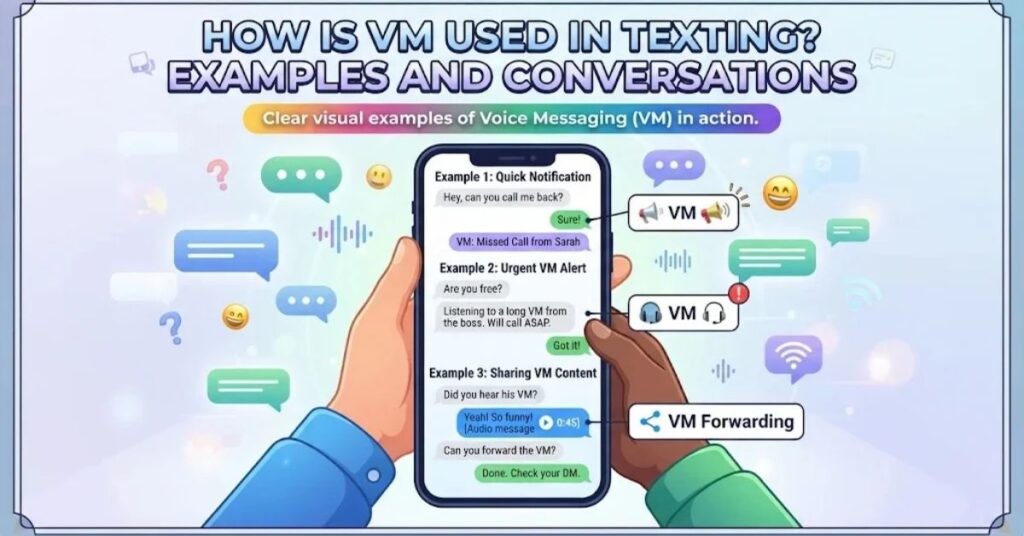
Understanding real conversations makes abbreviations easier to recognize. Here are some situations where people might use VM.
Example 1: Sending an Audio Message
A: Can you explain the assignment?
B: Sure, I’ll send you a VM.
Meaning: The person will record an audio explanation instead of typing.
Example 2: Checking a Voice Message
A: Did you listen to my VM?
B: Not yet. I’ll check it after work.
Meaning: Someone wants to know whether the other person heard their recorded audio.
Example 3: Leaving a Voicemail
A: Did you talk to Mike?
B: No, he didn’t answer. I left him a VM.
Meaning: The speaker left a voicemail after an unanswered phone call.
Example 4: Requesting a Recorded Message
A: I don’t understand what happened.
B: I’ll send you a VM explaining everything.
Meaning: The sender plans to communicate through a recorded message.
Example 5: Discussing Technology
A: Where are you testing the new software?
B: Inside a VM running Linux.
Meaning: VM stands for virtual machine.
These examples show why you shouldn’t judge an abbreviation without understanding its surrounding conversation.
How Do You Know Which Meaning of VM Someone Intended?
Not sure what someone means? A few simple clues can help you identify the correct definition.
1. Read the surrounding words
Words such as send, listen, audio, record, and message usually suggest a voice message.
Meanwhile, call, missed, answer, phone, and leave often point toward voicemail.
2. Consider the platform
If you’re chatting with a friend on WhatsApp, a voice message is a reasonable interpretation.
If you’re discussing a missed telephone call, voicemail makes more sense.
3. Think about the conversation topic
Technology-related words such as server, software, operating system, and installation usually indicate a virtual machine.
4. Check the previous messages
Sometimes, one earlier sentence provides the answer.
For example, I called twice, but you didn’t answer. I left a VM clearly suggests voicemail.
How Do You Respond When Someone Says VM?
Your response depends on the meaning behind the abbreviation. You don’t need a complicated reply. Keep it natural and friendly.
If VM Means Voice Message
You can respond with:
- Sure, I’ll listen to it.
- Send it whenever you’re free.
- I just listened to your message.
- I’ll check it in a minute.
If VM Means Voicemail
Try these responses:
- I’ll check my voicemail.
- Sorry, I missed your call.
- I just heard your message.
- I’ll call you back soon.
If You’re Not Sure What They Mean
It’s perfectly fine to ask:
- Do you mean a voice message or voicemail?
- Are you talking about an audio recording?
- Did you mean the message you left after calling?
Asking for clarification is better than responding to the wrong meaning.
Is VM Formal or Informal?
VM is generally an informal abbreviation in everyday messaging. People use it to save time when chatting with friends, family members, and familiar contacts.
However, writing the complete phrase is usually better in professional situations.
| Situation | Better Expression |
|---|---|
| Texting a friend | I sent you a VM. |
| Casual group chat | Check your VM. |
| Professional email | I left you a voicemail. |
| Workplace communication | Please listen to my voice message. |
| Academic writing | Use the complete phrase. |
If you’re communicating with someone unfamiliar with texting abbreviations, spell out voice message or voicemail.
Clear language matters more than saving two or three letters.
Is VM Slang or an Abbreviation?
VM is better described as an abbreviation or initialism rather than traditional slang.
An abbreviation is a shortened form of a word or phrase. An initialism uses the first letters of multiple words, pronounced individually.
For example:
- VM = Voice Message.
- VM = Voicemail.
- VM = Virtual Machine.
Slang refers to informal expressions commonly used within particular groups or communities.
Although people use VM in casual conversations, that doesn’t automatically make it slang. It’s simply a convenient shortened form whose meaning depends on context.
Common Mistakes When Interpreting VM
Even a short abbreviation can create confusion. Here are some mistakes people commonly make.
1. Assuming VM Always Means Voice Message
Voice message is common in online chats, but phone-related conversations may use VM for voicemail.
2. Thinking VM Always Means Voicemail
When someone says they sent you a VM through a messaging app, they may mean an audio recording.
3. Ignoring Conversation Context
The surrounding words often explain the intended definition. Never rely on the abbreviation alone.
4. Treating Every Abbreviation as Slang
Not every shortened expression is slang. VM also has established meanings in telephone and computing terminology.
5. Assuming Gender Changes the Meaning
VM doesn’t have a different definition when a girl or guy uses it. The conversation matters much more than the sender’s gender.
Is VM the Same as a Voice Note?
VM and voice note can describe similar types of digital communication.
Both involve recording spoken words and sending the audio to another person. Different messaging applications and users may prefer different expressions.
You might encounter these related terms:
- Voice message
- Voice note
- Audio message
- Voice recording
For example, if someone says I’ll send you a voice note, they’re generally talking about the same kind of communication as a voice message.
However, VM isn’t a universally standardized abbreviation for every one of these expressions.
Why Do People Use VM in Texting?
People use abbreviations because they make everyday digital communication quicker and easier.
Instead of repeatedly typing voice message or voicemail, someone can simply write VM when the meaning is already clear.
Here are some reasons people use it:
- Saves time: Short abbreviations make quick conversations easier.
- Convenience: You don’t need to type the complete phrase.
- Familiarity: Regular texters often understand common shortened expressions.
- Casual communication: Abbreviations fit naturally into friendly conversations.
- Less repetition: Short forms are useful when discussing the same subject repeatedly.
However, abbreviations aren’t always helpful. If someone doesn’t recognize VM, the shortened expression might create unnecessary confusion.
Similar Texting Abbreviations
VM is one of many shortened expressions used in online conversations. Learning related abbreviations can make texting easier to understand.
| Abbreviation | Full Meaning | Common Use |
|---|---|---|
| TBF | To Be Fair | Sharing a balanced opinion |
| OOTD | Outfit of the Day | Fashion and social media |
| TF | The Fuck | Strong reactions |
| GTFO | Get the Fuck Out | Surprise or disbelief |
| LOL | Laughing Out Loud | Expressing amusement |
| BRB | Be Right Back | Temporarily leaving a chat |
| TBH | To Be Honest | Giving an honest opinion |
| VN | Voice Note | Referring to recorded audio |
Some abbreviations are friendly and casual, while others can sound rude or inappropriate. Always consider the person you’re talking to and the situation.
Frequently Asked Questions
1. What does VM meaning in chat?
VM usually means voice message in casual chats. It can also mean voicemail when someone discusses phone calls.
2. What does VM stand for in texting?
VM commonly stands for voice message or voicemail. The surrounding conversation helps identify the intended meaning.
3. Does VM mean voicemail?
Yes. VM often means voicemail when someone talks about missed calls, unanswered calls, or recorded telephone messages.
4. What does VM mean on WhatsApp?
On WhatsApp, VM can informally refer to a voice message shared through a private chat or group conversation.
5. What does VM mean from a girl or guy?
VM has the same basic meaning regardless of gender. It usually refers to a voice message or voicemail.
6. Is VM the same as a voice note?
They can describe similar things. Both generally refer to recorded audio shared through a messaging application.
Conclusion
Understanding VM meaning in chat becomes easier when you consider the conversation. Most commonly, VM stands for voice message or voicemail. A voice message is an audio recording shared through a messaging application, while voicemail usually refers to a recording left after someone misses a phone call. In certain conversations, VM can also mean video message or virtual machine. Each definition belongs to a different situation. That’s why checking the surrounding words is always helpful.
The next time someone sends you VM, look at what they’re discussing before replying. If they mention listening or sending audio, they probably mean a voice message. If they mention an unanswered call, voicemail is more likely. And if the meaning still isn’t clear, simply ask. A quick question can prevent a misunderstanding and keep your conversation flowing naturally.

Abu Bakar is a meaning and language content writer with 2 years of experience. He specializes in explaining word meanings, definitions, phrases, and expressions through clear, informative, and easy-to-understand articles that help readers find accurate answers.